Title
Deterministic finite automata
A DFA can be visually specified by a state diagram:
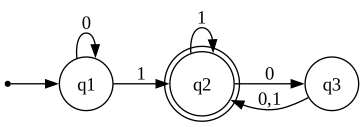
(A DFA can be seen as a special type of directed graph with labeled edges and nodes.)
- This example has three states (\(a\), \(b\), \(c\)):
- State \(a\) is the start state (denoted by an arrow pointing to it from nowhere).
- State \(b\) is an accept state (denoted by a double circle).
- The arrows between states are called transitions.
Operation of a DFA
- A DFA processes an input string one symbol at a time.
- After reading the last input symbol, it produces a Boolean output: “accept” or “reject” depending on whether it ends up in an accept state.
Example processing the string 1101:
1101
Begin in the start state \(a\).
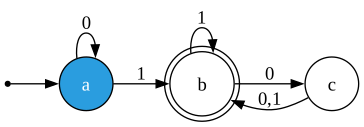
Read
1and transition to state \(b\).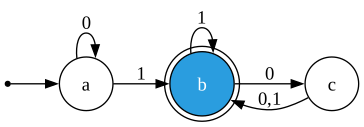
1101
Read
1and transition to state \(b\).1101
Read
0and transition to state \(c\).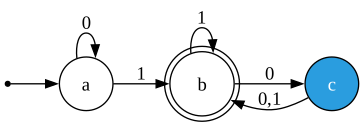
1101
Read
1and transition to state \(b\).1101
Since the final state \(b\) is an accept state, the DFA accepts the string.
Operation of a DFA
Which string(s) below are accepted by this DFA?
Formal definition of a DFA (syntax)
The formal definition of syntax of a model of computation says what an instance of the model is. (Semantics is a formal definition of what the model does; more later.)
The DFA above has five associated objects that we need to formalize:
- A set of states (\(\{a, b, c\}\)) — call this \(Q\).
- A set of symbols that it expects to read
from the input string (\(\{0, 1\}\)) — call this \(\Sigma\). - Rules for moving between states when
these symbols are read (the arrows) — ??? - A start state (\(a\)).
- Accept/“final” states (\(\{b\}\)). — call this \(F\).
How do we formalize the transitions?
- An arrow from state \(x\) to state \(y\) labeled with symbol \(\sigma\) means: when the DFA is in state \(x\) and reads \(\sigma\) from the input, it transitions to \(y\).
- Think of this as a function that maps \((x, \sigma)\) to \(y\).
- We call this function the transition function \(\delta\): \[ \delta(x, \sigma) = y \quad \quad \quad \fragment{\delta: Q \times \Sigma \to Q} \]
Translating a state diagram into the formal definition
We can formally describe this DFA as \(M_1 = (Q, \Sigma, \delta, a, F)\) where:
\(Q = \{a, b, c\}\)
\(\Sigma = \{0, 1\}\)
\(\delta\) is defined by the following lookup table:
\(0\) \(1\) \(a\) \(a\) \(b\) \(b\) \(c\) \(b\) \(c\) \(b\) \(b\) \(a\) is the start state.
\(F = \{b\}\)
The language decided by a DFA
- The set of strings \(A\) that a machine \(M\) accepts is called the language decided by \(M\).
- We denote this formally as \(L(M) = A\).
- This means \(M\) decides the language \(A\). (Some authors say recognizes.) Note: We say \(M\) accepts or rejects strings, but it decides languages.
- If \(M\) accepts no strings (e.g., \(F = \emptyset\)), does it decide a language? Yes: \(L(M) = \emptyset\).
- What is the language of our example DFA above (\(M_1\))?
- The strings it accepts must end in a
1followed by an even number of0s. - So, \(L(M_1) = \setbuild{w \in \{0, 1\}^*}{w \text{ has at least one } 1 \text{ and has an even number of } 0\text{s after the last } 1 }\).
- How can we prove this formally? Using the upcoming formal definition of computation!
- The strings it accepts must end in a
Some more examples
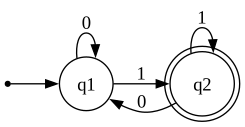
What is the formal description of this DFA?
\[M_2 = (\fragment{\{a, b\},} \fragment{\{0, 1\},} \fragment{\delta,} \fragment{a,} \fragment{\{b\}}),\]
where \(\delta\) is defined by the table:
| \(0\) | \(1\) | |
|---|---|---|
| \(a\) | \(a\) | \(b\) |
| \(b\) | \(a\) | \(b\) |
What language does this DFA decide?
Some more examples
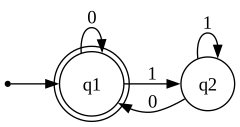
What is the formal description of this DFA?
\[M_3 = (\{a, b\}, \{0, 1\}, \delta, a, \{a\}),\]
where \(\delta\) is defined by the table:
| \(0\) | \(1\) | |
|---|---|---|
| \(a\) | \(a\) | \(b\) |
| \(b\) | \(a\) | \(b\) |
What language does this DFA recognize?
\[ L(M_3) = \setbuild{w \in \{0, 1\}^*}{w[|w|] = 0} \fragment{\cup \{\emptystring\}} \fragment{= \setcomplement{L(M_2)}} \]
DFA design example: String length modulo 3
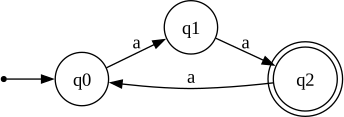
Task: Design a DFA that accepts strings of symbol \(\string{a}\) whose length is of the form \(3n + 2\)
\[ \setbuild{\string{a}^{3n + 2}}{n \in \N} = \setbuild{w \in \{\string{a} \}^*}{|w| \equiv 2 \mod 3} = \string{\{aa, aaaaa, \ldots\}} \]
- What do we need to keep track of?
- The length of the string modulo 3: 0, 1, or 2.
- What states and transitions do we need?
DFA design example: Substring
Task: Design a DFA that accepts binary strings that contain the substring \(\string{001}\).
What do we need to keep track of? Which parts of this substring have we seen so far?
What states do we need?
- \(q\): input processed so far does not contain 001 or end with 0 or 00
- \(q_0\): we just saw a single 0
- \(q_{00}\): we just saw two 0s
- \(q_{001}\): the full target substring \(\string{001}\) has been seen
What are the transitions?
\(0\) \(1\) $q $ \(\fragment{q_0}\) \(\fragment{q }\) $q_0 $ \(\fragment{q_{00}}\) \(\fragment{q }\) $q_{00} $ \(\fragment{q_{00}}\) \(\fragment{q_{001}}\) $q_{001} $ \(\fragment{q_{001}}\) \(\fragment{q_{001}}\) 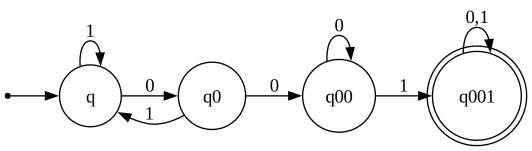
DFA design example: Finite language
Task: Design a DFA that accepts strings that are in a given finite language.
Solution: Build a trie (prefix tree) data structure!
Example: \(A = \string{\{0, 000, 001, 1001, 1010, 10010\}}\)
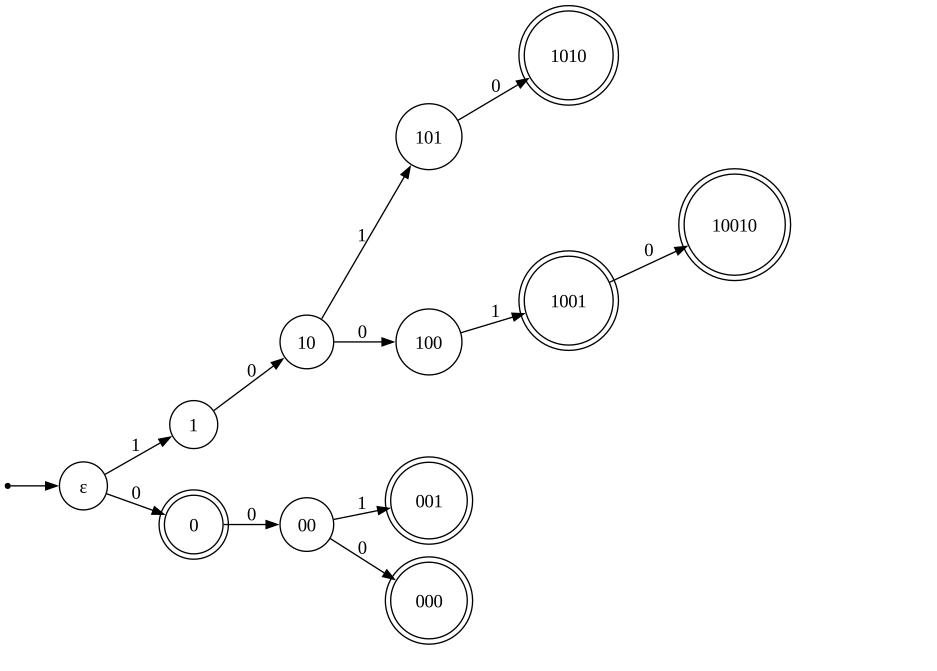
- One state for each prefix of a string in \(A\)
(the input read so far). - Accept states: the strings in \(A\)
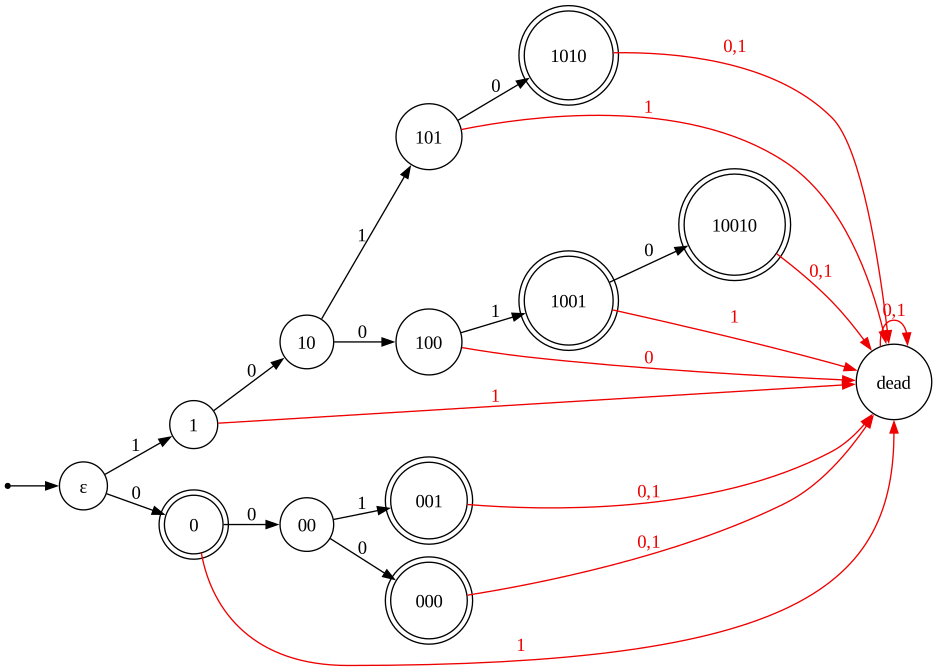
(not only leaves: \(\string{0}\) and \(\string{1001}\) are prefixes of other strings in \(A\)). - Every state needs a transition on every symbol:
missing ones go to a dead state that never accepts.
Formal definition of computation: Example
| \(0\) | \(1\) | |
|---|---|---|
| \(a\) | \(a\) | \(b\) |
| \(b\) | \(c\) | \(b\) |
| \(c\) | \(b\) | \(b\) |
According to the formal definition of computation, this DFA accepts the string \(w = \string{0100100}\) because the sequence of states it enters when processing this string is: \[ (r_0, r_1, r_2, r_3, r_4, r_5, r_6, r_7) = (a, a, b, c, b, b, c, b) \] which satisfies the three conditions:
- \(r_0 = a\) (the start state)
- \(r_7 = b \in F\) (the last state is an accept state)
- The transition rules are satisfied: \(a \xrightarrow{0} a \xrightarrow{1} b \xrightarrow{0} c \xrightarrow{0} b \xrightarrow{1} b \xrightarrow{0} c \xrightarrow{0} b\)