Title
Declarative models of computation
- Our first model of computation, the DFA, is like an imperative programming language.
- It defines a language by precisely defining every step that should be followed to accept/reject a string.
- It is easy to translate the DFA into a imperative program, e.g., using a
switchstatement, lookup table, orgotoinstructions.
- In contrast, the next models of computation that we will study are declarative.
- They describe the strings in a language without giving specific processing steps.
- The first, regular expressions, are patterns describing a set of strings.
- The second, context-free grammars, give rules to generate strings that should be accepted;
they turn out to be more powerful than regular expressions. - The third, nondeterministic finite automata, are like DFAs but are less imperative since they do not define specific steps to follow.
Regular expressions
- Extremely useful for searching and manipulating text:
- Advanced search/replace features in text editors
- Major reason for the popularity of the
Perlprogramming language (featuring built-in regex support) - The
sed,awk, andgrepPOSIX commands
(the namegrepcomes fromg/re/p, a command inedto run a run a global regular expression search and print the matched lines)
- Used to tokenize input strings in the
front-end of a compiler. - Turn out to be equivalent to DFAs in terms of the languages they can describe.
- We’ll eventually see how to convert a regular expression into a DFA and vice versa.
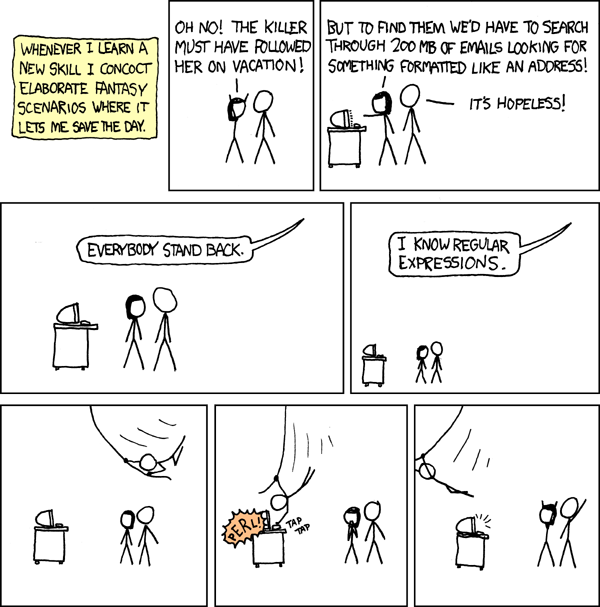
Regular expressions
Just like an arithmetic expression \[(5 + 3) \times 4\] is a string built from numbers and operators that evaluates to a numerical value,
a regular expression (regex) is a string built from symbols and special operators like \[
(0 \cup 1) 0^*
\] that evaluates to a language (set of strings).
Most regex tools replace \(\cup\) with |, e.g., (0|1)0*. Use \(\cup\) when handwriting (e.g., on an exam) to avoid confusing | and \(1\).
- Intuitively: regexes are patterns that match certain strings and not others.
- We can understand this expression as shorthand for building the language it decides.
- Symbols \(0\) and \(1\) are shorthand for singletons \(\{0\}\) and \(\{1\}\).
- So \((0 \cup 1)\) is really the language \(\{0, 1\}\), and \(0^*\) is \(\{0\}^*\).
- \((0 \cup 1) 0^*\) is thus the concatenation of these two languages \[ L((0 \cup 1) 0^*) = \{0, 1\} \circ \{0\}^* = \{0, 1, 00, 10, \ldots \} \]
Basic examples
- The regular expression \[ (0 \cup 1)^* \quad \quad \fragment{L((0 \cup 1)^*) = \{0, 1\}^*} \] defines/matches all strings over \(\{0, 1\}\).
- If \(\Sigma\) is any alphabet, then
- \(\Sigma\) is a regex that matches all strings of length 1 over \(\Sigma\).
- \(\Sigma^*\) matches all strings over \(\Sigma\).
- \(\Sigma^* 1\) matches all strings over \(\Sigma\) that end with a 1.
- \((0 \Sigma^*) \cup (\Sigma^* 1)\) matches all strings that
start with a 0 or end with a 1
Operator Precedence
*has highest precedence,
followed by concatenation, then \(\cup\)
(analogous to exponentiation, multiplication, and addition).- Use parentheses to override this order. \[ 0 \cup 1 \Sigma^* \quad \text{ vs } \quad (0 \cup 1) \Sigma^* \]
- We could write \((0 \Sigma^*) \cup (\Sigma^* 1)\) equivalently as \(0 \Sigma^* \cup \Sigma^* 1\)
Formal definition of regular expressions
We now define both syntax (valid expressions) and semantics (languages they decide) of regexes.
Let \(\Delta = \{ \cup, (, ), *, \emptyset, \emptystring \}\) be the regex control alphabet.
Let \(\Sigma\), the input alphabet, satisfy \(\Sigma \cap \Delta = \emptyset\).
\(R \in (\Sigma \cup \Delta)^*\) is a regular expression deciding language \(L(R) \subseteq \Sigma^*\) if one of the following holds:
This is an inductive definition!
- (base) \(R = a\) for some \(a \in \Sigma\). Then \(L(R) = \{a\}\).
- (base) \(R = \emptystring\). Then \(L(R) = \{\emptystring\}\).
- (base) \(R = \emptyset\). Then \(L(R) = \{\}\).
- (inductive) \(R = (R_1) \cup (R_2)\) for \(R_1, R_2\) regexes. Then \(L(R) = L(R_1) \cup L(R_2)\).
- (inductive) \(R = (R_1)(R_2)\) for \(R_1, R_2\) regexes. Then \(L(R) = L(R_1) \circ L(R_2)\).
- (inductive) \(R = (R_1)^*\) for \(R_1\) a regex. Then \(L(R) = L(R_1)^*\).
Parentheses can be omitted, in which case the precedence rules apply.
A language \(A\) is regex-decidable if there is a regex \(R\) such that \(L(R) = A\). In Chapter 6 we prove that a language is regex-decidable if and only if it is DFA-decidable.
Some conventions and convenient notation
- Sometimes we don’t distinguish between \(R\) and \(L(R)\).
- Remember that \(R^*\) allows 0 repetitions of \(R\) (matching the empty string).
- What if we want to match 1 or more repetitions of \(R\)? \(R R^*\)
- We can use the shorthand \(R^+\) for \(RR^*\).
- \(R^+ \cup \emptystring = \fragment{R^*}\)
- We use \(R^k\) to denote \(R\) repeated exactly \(k\) times.
- \(R^0 = \emptystring\)
- \(R^1 = R\)
- \(R^k = \underbrace{R\ldots R}_k\) where \(k\) is a constant, e.g., \(R^3 = RRR\)
Examples
In the following examples, we assume that \(\Sigma = \{0, 1\}\).
- \(0^* 1 0^* = \fragment{\setbuild{w \in \Sigma^*}{w \text{ contains a single 1}}}\)
- \(\Sigma^* 1 \Sigma^* = \fragment{\setbuild{w \in \Sigma^*}{w \text{ has at least one 1}}}\)
- \(\setbuild{w \in \Sigma^*}{w \text{ has at least two 1's}} = \fragment{\Sigma^* 1 \Sigma^* 1 \Sigma^*}\)
- \(\setbuild{w \in \Sigma^*}{w \text{ has exactly two 1's}} = \fragment{0^* 1 0^* 1 0^*}\)
- \(\setbuild{w \in \Sigma^*}{w \text{ contains the substring 001}} = \fragment{\Sigma^* 001 \Sigma^*}\)
- \(\setbuild{w \in \Sigma^*}{\text{ every 0 in $w$ is followed by at least one 1}} = \fragment{1^* (01^+)^*}\)
- \(\setbuild{w \in \Sigma^*}{|w| \text{ is even}} = \fragment{(\Sigma\Sigma)^*}\)
- \(\setbuild{w \in \Sigma^*}{w \text{ starts and ends with the same symbol}} = \fragment{0\Sigma^*0\ \cup\ 1\Sigma^*1}\fragment{\ \cup\ 0\ \cup\ 1}\)
Algebra of regular expressions
- Regular expressions satisfy the “distributive law”: \[ A(B \cup C) = AB \cup AC \] (Think of \(\cup\) as analogous to addition and concatenation as multiplication.)
- So FOIL works: \(L((0 \cup \varepsilon) (1 \cup \varepsilon)) = \{01, 0, 1, \varepsilon\}\)
- \(\emptyset\) is identity for \(\cup\) (like 0 is identity for +) \[ R \cup \emptyset = R, \quad \quad R \emptyset = \emptyset \]
- \(\emptystring\) is identity for concatenation (like 1 is identity for \(\times\)) \[ R \emptystring = R \]
Matching a floating-point literal
Suppose you’re writing a compiler for a programming language
- In the first step, you need to break down the input string into tokens that could represent variable names, keywords, operators, and constants.
- This is generally done by a lexer defined by regex’s matching each token type.
- Let’s try to do this for floating-point literals with an optional fractional part and sign.
- Let \(P = 1 \cup 2 \cup \ldots \cup 9\) and \(D = 0 \cup P\).
- Integer subexpression: either 0 or a nonempty string of digits not starting with 0: \(I = 0 \cup \fragment{P D^*}\)
- Could be a decimal number with a nonempty integer part: \(\fragment{I . D^*}\)
- Or a decimal number with no integer part and nonempty fractional part: \(\fragment{. D^+}\)
- The leading sign part could be \(-\), or missing: \(\fragment{(- \cup \emptystring)}\)
- Putting everything together, we get \[ (- \cup \emptystring)(I . D^* \cup . D^+) \hspace{10em} \]