Title
Turing machine (TM)
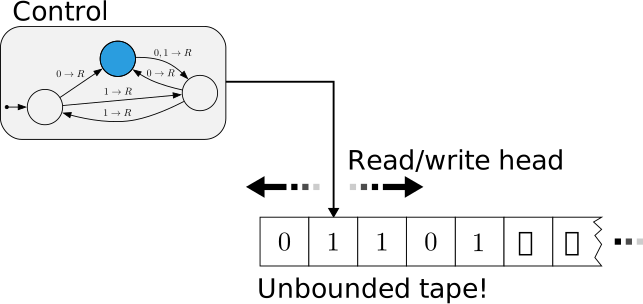
Distinctive features of Turing machines:
- They can read and write symbols on the tape.
- The tape has symbols outside the input alphabet (e.g., the blank symbol “⎵”).
- The read/write head can move right, left, or stay in place according to the control logic.
- The tape is unbounded to the right and input starts at the leftmost cell.
- If the head moves to the right of the current rightmost cell, a new “⎵” cell is created.
- Sipser says “the tape is infinite,” but a more realistic mental model is a growable array
(e.g., Pythonlist, C++std::vector, Javajava.util.List).
- They have exactly one accept state and one reject state
and halt immediately when either is reached.
Turing machine (TM)
- Once we gain intuition for TMs,
we can describe the machine solving
a given problem at a high-level while still being precise. - Example: design a TM to decide \(P = \setbuild{w \in \{0, 1\}^*}{w = \reverse{w}}\)
- The TM will:
- “Zig-zag” back and forth between the left and right ends of the input, checking if the leftmost symbol equals the rightmost symbol. If not, reject immediately.
- “Cross off” symbols as they are checked by overwriting them with an \(\string{x}\) symbol.
- Continue until the entire input is crossed off, at which point the TM accepts.
Formal definition of a Turing machine: Example
\[ P = \setbuild{w \in \{0, 1\}^*}{w = \reverse{w}} \]
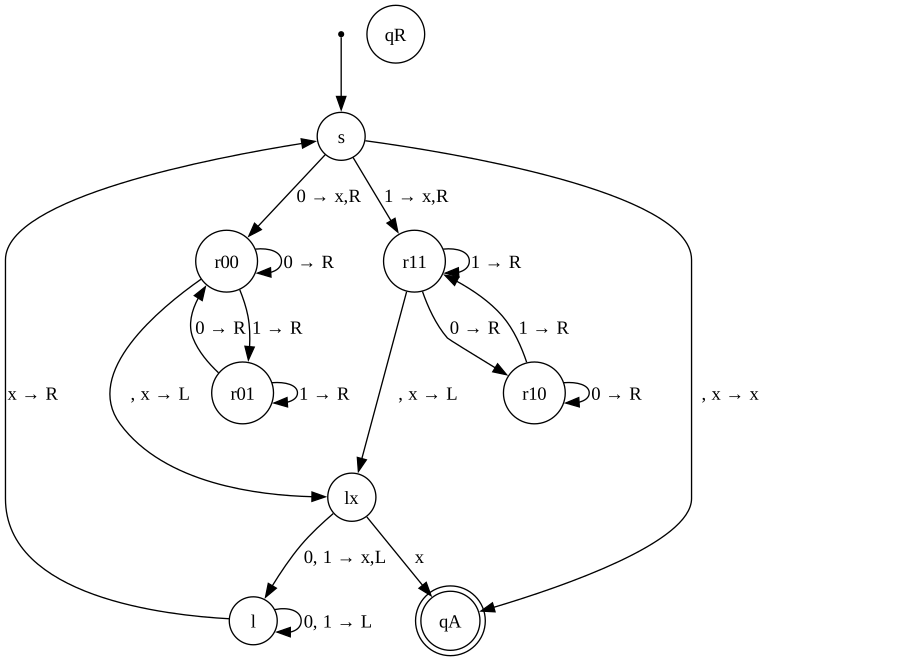
\(M = (Q, \Sigma, \Gamma, \delta, s, q_a, q_r)\) where:
- \(Q = \{s, r_{00}, r_{11}, r_{01}, r_{10}, \string{lx}, \string{l}, q_A, q_R\}\)
- \(\Sigma = \{0, 1\}\)
- \(\Gamma = \{0, 1, \string{x}, ⎵\}\)
- \(s\) is the start state, \(q_A\) is the accept state,
and \(q_R\) is the reject state - \(\delta\) is defined by the arrows in the diagram…
Formal definition of computation for Turing machines
How can we describe the “full state” that a Turing machine is in (including its tape)?
A configuration of a TM \(M = (Q, \Sigma, \Gamma, \delta, s, q_a, q_r)\) is a triple: \(C = (q, p, w)\) where:
- \(q \in Q\) is the current state of the TM.
- \(p \in \N^+\) is the tape head position.
- \(w \in \Gamma^\infty\) is a one-way infinite sequence holding the tape content
Sipser uses a different notation “\(u\, q\, v\)” where \(w=uv\) and \(p = |u| + 1\).
Example: \(1011q_70111\).
See Optional Section 8.4 for a definition (uglier) using a finite, growable tape.
Formal definition of computation for Turing machines
A configuration of a TM \(M = (Q, \Sigma, \Gamma, \delta, s, q_a, q_r)\) is a triple: \(C = (q, p, w)\) where:
- \(q \in Q\) is the current state of the TM.
- \(p \in \N^+\) is the tape head position.
- \(w \in \Gamma^\infty\) is a one-way infinite sequence holding the tape content
We define computation by formally specifying how one configuration \(C = (q, p, w)\) transitions to the next configuration \(C' = (q', p', w')\).
We say \(C\) yields \(C'\) (writing \(C \to C'\)) when \(M\) can legally go from \(C\) to \(C'\) in one step: \[ \delta(q, w[p]) = (\fragment{q'}, \fragment{w'[p]}, \fragment{m}) \hspace{5em} \]
We identify moves \(m \in \{L, R, S\}\) with offsets \(\{-1, +1, 0\}\) added to \(p\).
- \(p' = \max(1, p + m)\)
(Move tape head according to \(m\) but don’t go off the left end.) - \(w[i] = w'[i]\) for all \(i \ne p\)
(Leave all other tape cells unchanged.)
- \(p' = \max(1, p + m)\)
Formal definition of computation for Turing machines
A configuration of a TM \(M = (Q, \Sigma, \Gamma, \delta, s, q_a, q_r)\) is a triple: \(C = (q, p, w)\) where:
- \(q \in Q\) is the current state of the TM.
- \(p \in \N^+\) is the tape head position.
- \(w \in \Gamma^\infty\) is a one-way infinite sequence holding the tape content
A configuration \((q, p, w)\) is called:
accepting if \(q = q_a\), rejecting if \(q = q_r\), halting if \(q \in \{q_a, q_r\}\).\(M\) accepts/rejects input \(w \in \Sigma^*\) if there is a finite sequence of configurations \(C_1, C_2, \ldots, C_k\) such that:
- \(C_1 = (\fragment{s}, \fragment{1}, \fragment{w \string{⎵}^\infty})\)
- \(C_i \to C_{i+1}\) for all \(1 \leq i < k\)
- \(C_k\) is accepting/rejecting
If \(M\) neither accepts nor rejects \(w\), we say \(M\) loops (does not halt) on \(w\).
- Three possible outcomes: accept, reject, or loop!
- Defining the languages “recognized” or “decided” by a TM requires more care than with FAs or CFGs.