Title

ECS 120 Theory of Computation
Equivalence of regex’s and NFAs
David Doty (adapted from slides authored by Julian Panetta)
University of California, Davis

Equivalence of regex’s and NFAs

  • NFAs and DFAs have equivalent computational power.
  • Regular grammars and DFAs have equivalent computational power.

Next:

  • Prove that NFAs and regex’s have equivalent computational power.
    Strategy: inductive constructions that incrementally build up the regex/NFA (bottom up from base cases).
  • Conclude that the following classes of languages are actually all the same, henceforth called regular = DFA-decidable = NFA-decidable = regex-decidable = RG-decidable

Implementing regex’s with NFAs

Theorem: Any regex-decidable language is NFA-decidable.

Proof

Recall the formal definition:

\(R\) is a regular expression deciding language \(L(R) \subseteq \Sigma^*\) if one of the following holds:

  1. (base) \(R = a\) for some \(a \in \Sigma\). Then \(L(R) = \{a\}\).
  2. (base) \(R = \emptystring\). Then \(L(R) = \{\emptystring\}\).
  3. (base) \(R = \emptyset\). Then \(L(R) = \{\}\).
  4. (inductive) \(R = (R_1) \cup (R_2)\) for regex’s \(R_1, R_2\). Then \(L(R) = L(R_1) \cup L(R_2)\).
  5. (inductive) \(R = (R_1)(R_2)\) for regex’s \(R_1, R_2\). Then \(L(R) = L(R_1) \circ L(R_2)\).
  6. (inductive) \(R = (R_1)^*\) for a regex \(R_1\). Then \(L(R) = L(R_1)^*\).

This inductive definition implies a “tree structure” that we can exploit to construct an NFA!

Implementing regex’s with NFAs

Theorem: Any regex-decidable language is NFA-decidable.

Proof

Inductive proof:

For any regular expression \(R\), we can construct an NFA \(N\) such that \(L(N) = L(R)\).

The base cases of the inductive definition are the base cases of the proof!

  1. If \(R = a\) for some \(a \in \Sigma\), then \(L(R) = \{a\}\) decided by the NFA
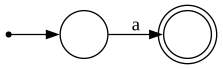
    data/images/regex_nfa/base_case_a.svg

  2. If \(R = \emptystring\), then \(L(R) = \{\emptystring\}\) decided by the NFA
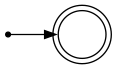
    data/images/regex_nfa/base_case_e.svg

  3. If \(R = \emptyset\), then \(L(R) = \{\}\) decided by the NFA
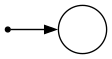
    data/images/regex_nfa/base_case_empty.svg

Implementing regex’s with NFAs

Theorem: Any regex-decidable language is NFA-decidable.

Proof

Inductive proof:

For any regular expression \(R\), we can construct an NFA \(N\) such that \(L(N) = L(R)\).

The recursive cases of the definition are the inductive steps of the proof!

  1. If \(R = (R_1) \cup (R_2)\) for \(R_1, R_2\) regexes, then \(L(R) = L(R_1) \cup L(R_2)\).

    \(L(R_1)\) and \(L(R_2)\) are both NFA-decidable by the inductive hypothesis.
    By closure of NFA-decidability under union, so is \(L(R) = L(R_1) \cup L(R_2)\)!

  2. If \(R = (R_1)(R_2)\) for \(R_1, R_2\) regexes, then \(L(R) = L(R_1) \circ L(R_2)\).

    \(L(R_1)\) and \(L(R_2)\) are both NFA-decidable by the inductive hypothesis.
    By closure of NFA-decidability under concatenation, so is \(L(R) = L(R_1) \circ L(R_2)\)!

  3. If \(R = (R_1)^*\) for \(R_1\) a regex, then \(L(R) = L(R_1)^*\).

    \(L(R_1)\)is NFA-decidable by the inductive hypothesis.
    By closure of NFA-decidability under Kleene star, so is \(L(R) = L(R_1)^*\)!

This completes the proof!

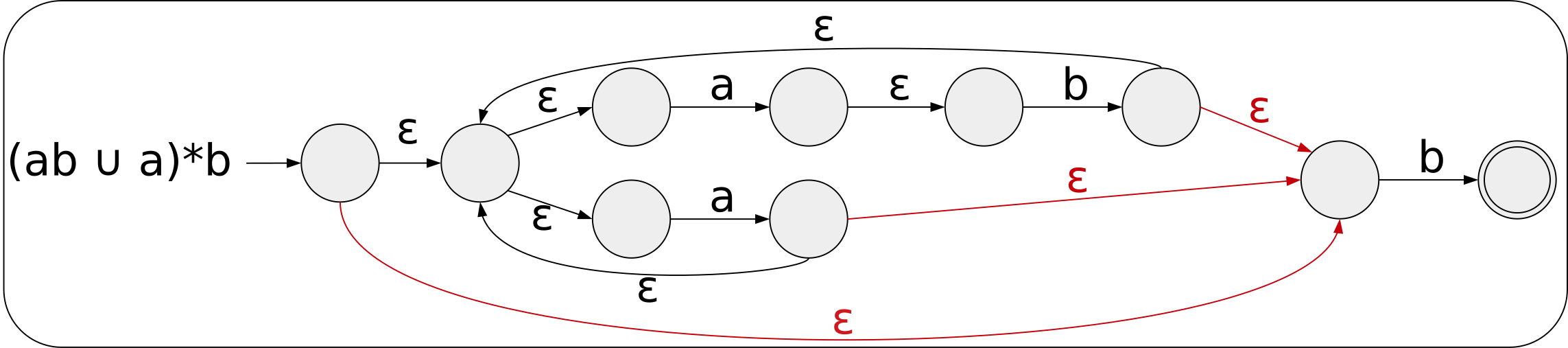
Implementing regex’s with NFAs example: \((a \cup ab)^* b\)

  • data/images/regex_nfa/regex2nfa-example-1.svg \(\stackrel{\Large \nwarrow}{\large \leftarrow}\) base cases

  • data/images/regex_nfa/regex2nfa-example-2.svg
  • Note that this is equivalent to the NFA data/images/regex_nfa/regex2nfa-example-optimized-ab.svg

True or False: Collapsing two NFA states connected by an \(\emptystring\)-transition always preserves its behavior.
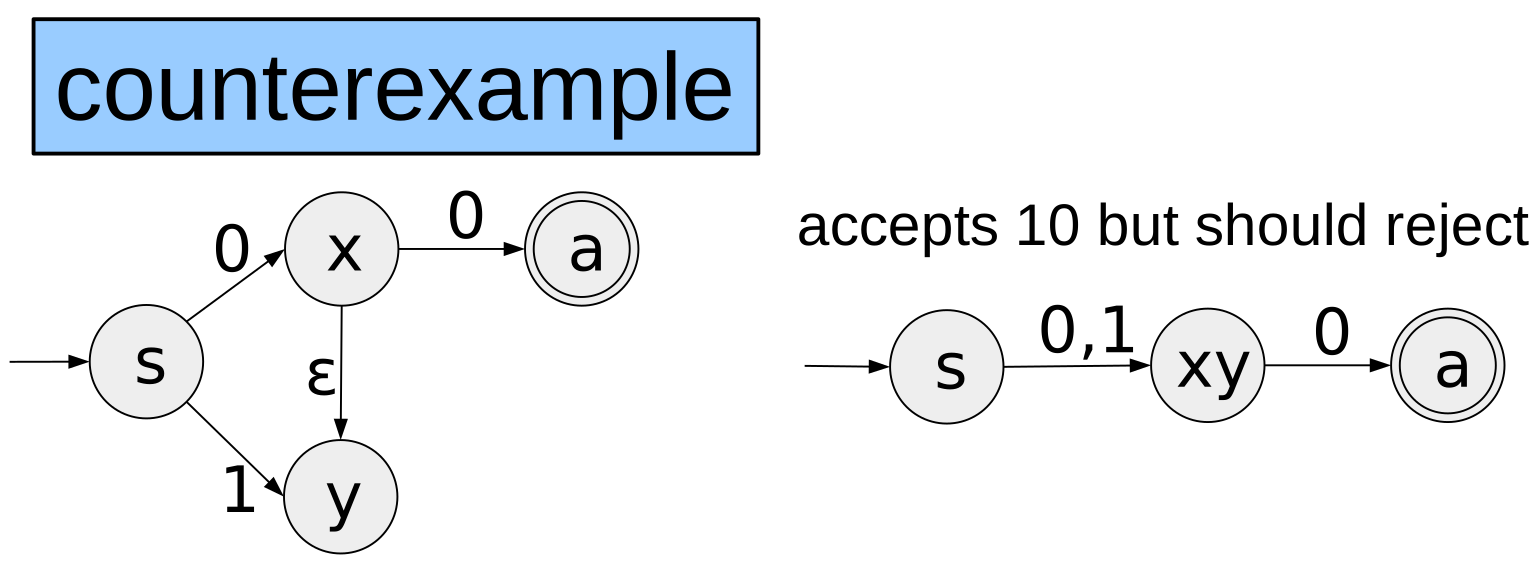
data/images/regex_nfa/nfa-collapse-eps-transition-inequivalent.svg

Implementing regex’s with NFAs example: \((a \cup ab)^* b\)

  • data/images/regex_nfa/regex2nfa-example-1.svg \(\stackrel{\Large \nwarrow}{\large \leftarrow}\) base cases
  • data/images/regex_nfa/regex2nfa-example-2.svg Don’t optimize by collapsing two states between \(\varepsilon\)-transition. (unsafe in general, even if it works in this special case)

  • data/images/regex_nfa/regex2nfa-example-3.svg
  • data/images/regex_nfa/regex2nfa-example-4.svg
  • data/images/regex_nfa/regex2nfa-example-5.svg

Converting NFAs to regex’s

Theorem: Any NFA-decidable language is regex-decidable.

Starting point: “Expression Automata” (EA) (or “Generalized NFAs” in Sipser)

Label the transition arrows of an EA with regular expressions that match substrings of the input rather than individual symbols.
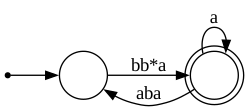
data/images/regex_nfa/expression_automaton.svg
  • ❌ \(\emptystring\)
  • ❌ \(\string{a}\)
  • ❌ \(\string{b}\)
  • ✅ \(\string{ba}\)
  • ✅ \(\string{bba}\)
  • ✅ \(\string{baa}\)
  • ❌ \(\string{baaba}\)
  • ✅ \(\string{baababa}\)
  • ✅ \(\string{baababa}\)
  • ✅ \(\string{bbaaababbba}\)
  • ❌ \(\string{bbaabab}\)
  • ❌ \(\string{bbaababab}\)

Converting NFAs to regex’s

Theorem: Any NFA-decidable language is regex-decidable.

Starting point: “Expression Automata” (EA; “Generalized NFAs” in Sipser)

Label the transition arrows of an NFA with regular expressions that match substrings of the input rather than individual symbols.

data/images/regex_nfa/expression_automaton.svg

Proof idea:

  • Any NFA \(N\) is already a valid EA.
  • Incrementally convert \(N\) into an equivalent EA \(E\) of the form:
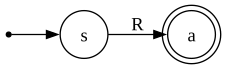
    data/images/regex_nfa/trivial_expression_automaton.svg
    where \(R\) is a regular expression.

Then \(L(N) = L(E) = L(R)\)!

Converting NFAs to regex’s: First step

In our first step, we modify \(N\) so that:

  • The start state has no inbound transitions.
  • There is a single accept state with no outbound transitions.
q0 q0 22fd2adf-a647-4d15-9846-7e093e6efb9d 22fd2adf-a647-4d15-9846-7e093e6efb9d->q0 q1 q1 q0->q1 b ε ε q1->q0 b q2 q2 q1->q2 a q2->q0 ε q0 a q0 s 22fd2adf-a647-4d15-9846-7e093e6efb9d->q0 22fd2adf-a647-4d15-9846-7e093e6efb9d->q0 ε

Given \(N = (Q, \Sigma, \Delta, q_0, F)\),
construct \(N' = (Q', \Sigma, \Delta', s, F')\):

  • \(Q' = Q \cup \{s, a\}\) where \(s, a \notin Q\)
  • \(F' = \{a\}\)
  • \(\Delta' = \Delta \cup \{s \stackrel{\emptystring}{\to} q_0\} \cup \setbuild{q \stackrel{\emptystring}{\to} a}{q \in F}\)

\(L(N') = L(N)\) because:
there is a computation sequence of \(N\) \(r_1, r_2, \ldots, r_n\) that accepts \(w\) if and only if \(s, r_1, r_2, \ldots, r_n, a\) is a computation sequence of \(N'\) accepting \(w\).

Converting NFAs to regex’s: Incremental simplification

We then apply incremental simplifications that remove the states “in the box” (not \(s\) or \(a\)) one by one:
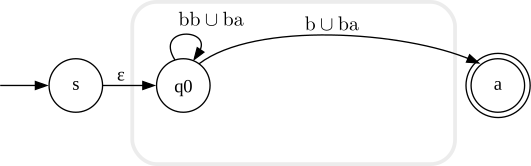
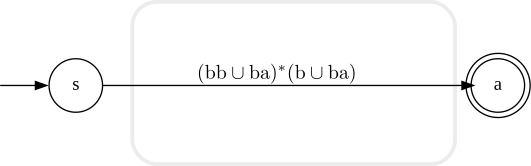
q1 q1 q0->q1 b ε q1->q0 b q1->q2 a q0 q0 q0 s 22fd2adf-a647-4d15-9846-7e093e6efb9d->q0 22fd2adf-a647-4d15-9846-7e093e6efb9d->q0 ε ε q2 q2 q1 q1 q0->q1 b ε q1->q0 b q1->q2 a q2->q0 ε q0 a
data/images/regex_nfa/generic_n_third_step.svg
data/images/regex_nfa/generic_n_fourth_step.svg

How does this work in general?

Converting NFAs to regex’s: Incremental simplification

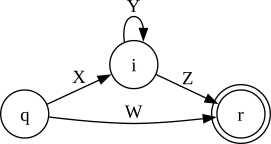
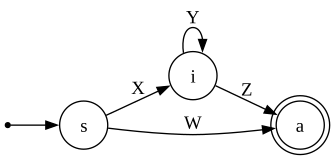
  • The final simplification step operates on an EA that looks like:
    data/images/regex_nfa/generic_last_step.svg
  • What strings take this EA from \(s\) to \(a\)? They either:

    • match \(W\),
    • or they start with a prefix matching \(X\), followed by zero or more substrings matching \(Y\), followed by a suffix matching \(Z\), i.e., strings that match \(X Y^* Z\).
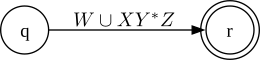
  • We can rip state “i” out of the diagram but still accept strings whose computation sequences go through \(i\), by changing the transition between \(s\) and \(a\):

    data/images/regex_nfa/generic_last_step_complete.svg
  • Both EAs accept exactly strings of the form \(w \in L(W)\), or of the form \(x y_1 y_2 \dots y_k z\) for some \(k \in \N\), where \(x \in L(X)\), each \(y_i \in L(Y)\), and \(z \in L(Z)\).

    • In general, some of the transitions may not exist, e.g., if there is no \(s \stackrel{W}{\to} a\) transition, use \(X Y^* Z\); if no self-loop on \(i\), use \(W \cup XZ\); if neither, then use \(XZ\).

Converting NFAs to regex’s: Incremental simplification

When more than three states remain:

  • Select any state other than \(s\) or \(a\) and call it \(i\).
  • Iterate over pairs of states \(q\) and \(r\) with transitions \(q \stackrel{X}{\to} i\) and \(i \stackrel{Z}{\to} r\) (even if \(q = r\))
  • For each of these pairs, transform:
    data/images/regex_nfa/generic_intermediate_step.svg into: data/images/regex_nfa/generic_intermediate_step_complete.svg
  • This new transition represents the ways to get from \(q\) to \(r\), without going through any other states other than possibly \(i\).
  • More precisely, iterate over pairs of transitions in/out of \(i\) (more on this in a bit).
  • Repeat until only \(s\) and \(a\) remain!

Example removing state \(i\)
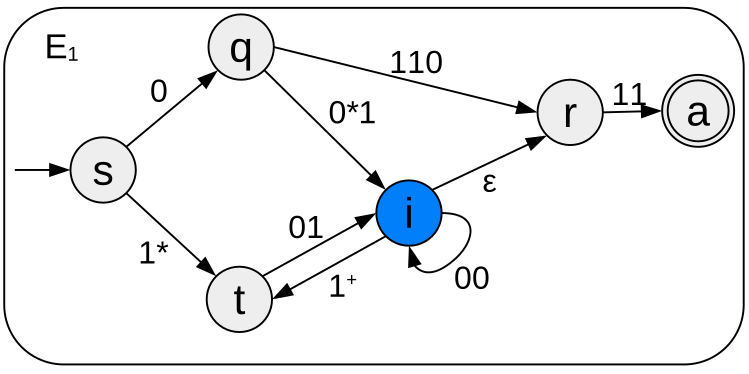
data/images/regex_nfa/ch6-ea-remove-state-before.svg

  • How to get from \(q\) to \(t\) going through \(i\)? \(0^*1\) (go from \(q\) to \(i\)) \((00)^*\) (loop on \(i\)) \(1^+\) (go from \(i\) to \(t\))
    • add new transition: \(q \stackrel{0^*1 (00)^* 1^+}{\to} t\)
  • How to get from \(q\) to \(r\) going through \(i\)? \(\fragment{0^*1} \fragment{(00)^*} \fragment{\emptystring} \fragment{= 0^*1 (00)^*}\)
    • replace existing \(q \stackrel{110}{\to} r\) transition with: \(q \stackrel{110\ \ \cup\ \ 0^*1(00)^*}{\to} r\)
  • How to get from \(t\) to \(r\) going through \(i\)? \(\fragment{01 (00)^* \emptystring = 01 (00)^*}\)
    • add new transition: \(t \stackrel{01(00)^*}{\to} r\)
  • How to get from \(t\) to \(t\) going through \(i\)? \(\fragment{01 (00)^* 1^+}\)
    • add new self-transition: \(t \stackrel{01(00)^*1^+}{\to} t\)
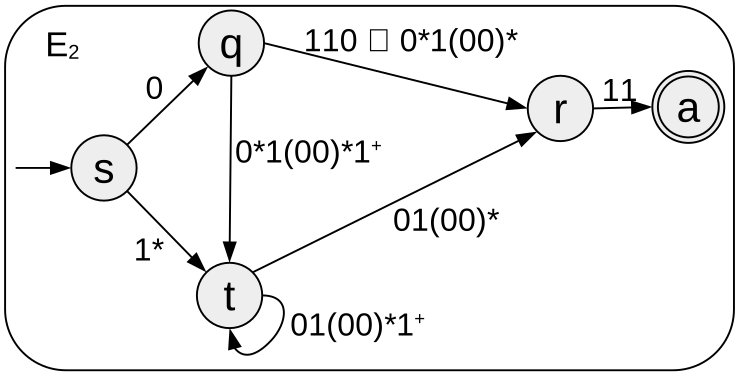
data/images/regex_nfa/ch6-ea-remove-state-after.svg

Other pairs of states, e.g., (\(s,r\) or \(q,q\)), not listed because either the first has no transition to \(i\) or the second has no transition from \(i\).

Process all pairs of transitions in/out of \(i\)

  • More generally, when removing a state \(i\), we must consider all pairs of transitions in/out of \(i\), along with the states they come from/go to.
  • We often write two transitions with the same from/to states with a single arrow, for example, \(q \stackrel{0,1}{\to} i\)… Technically these are two different transitions: \(q \stackrel{0}{\to} i\) and \(q \stackrel{1}{\to} i\).
  • Alternatively (and more conveniently when transforming an NFA to a regex by hand), one could think of the two NFA transitions represented by \(q \stackrel{0,1}{\to} i\) as a single EA transition \(q \stackrel{0 \cup 1}{\to} i\).

Example (Sipser, Figure 1.69): Regex’s get large quickly!

Theorem: (not proven in this class) There are NFAs with \(n\) states such that any equivalent regex has length at least \(2^{n-1}\)!

Summary

Let \(L\) be a language; the following are equivalent:

  • \(L\) is DFA-decidable.
  • \(L\) is NFA-decidable.
  • \(L\) is regex-decidable.
  • \(L\) is RG-decidable.

From now on, we simply use the term regular.