A Boolean formula \(\phi\) is satisfiable if there is an assignment of truth values to its variables that makes the formula evaluate to \(1\).
We introduce the Boolean satisfiability problem:
\[ \probSAT = \setbuild{\encoding{\phi}}{ \phi \text{ is a satisfiable Boolean formula }} \]
We know \(\probSAT \in \NP\) because we can easily implement a polynomial-time decider for:
\[ \verifier{\probSAT} = \setbuild{\encoding{\phi, w}}{ \phi \text{ is a Boolean formula, and } \phi(w) = 1 } \]
Recall the the \(k\)-clique problem (clique = set of nodes with edges between all pairs): \[ \probClique = \setbuild{\encoding{G, k}}{ G \text{ is an undirected graph with a } k\text{-clique}} \]
We now introduce a closely related problem, the \(k\)-independent set problem (independent set = set of nodes with edges between no pairs): \[ \probIndSet = \setbuild{\encoding{G, k}}{ G \text{ is an undirected graph with a } k\text{-independent set}} \]
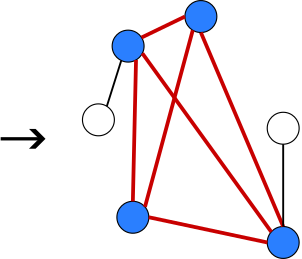
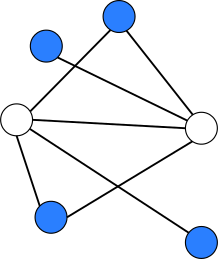
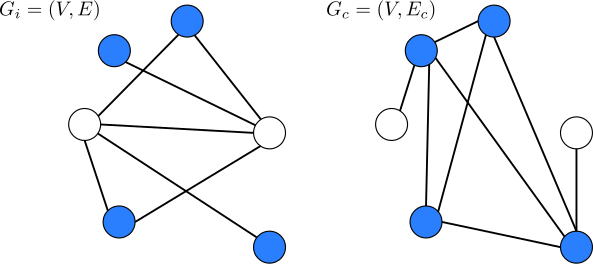
Given input \(\encoding{G_i, k}\) for \(\probIndSet\),
how can we convert it to input \(\encoding{G_c, k}\) for \(\probClique\) such that:
\[ \encoding{G_i, k} \in \probIndSet \iff \encoding{G_c, k} \in \probClique \]
A function \(f: \binary^* \to \binary^*\) is polynomial-time computable if there is a polynomial-time algorithm that, given input \(x\), computes \(f(x)\).
Let \(A, B \subseteq \binary^*\) be decision problems. We say \(A\) is polynomial-time reducible to \(B\)
if there is a polynomial-time computable function \(f\) such that for all \(x \in \binary^*\):
\[ \fragment{x \in A \iff f(x) \in B} \]
We denote this by \(A \le^\P B\).
\(A \le^\P B\) means: “B is at least as hard as A” (to within a polynomial-time factor).
from itertools import combinations as subsets
def reduction_from_independent_set_to_clique(G: Graph[Node], k: int) -> tuple[Graph[Node], int]:
V, E = G
Ec = [ {u,v} for (u,v) in subsets(V,2)
if {u,v} not in E and u!=v ]
Gc = (V, Ec)
return (Gc, k)
# Hypothetical polynomial-time algorithm for Independent Set
def independent_set(G: Graph[Node], k: int) -> bool:
Gp, kp = reduction_from_independent_set_to_clique(G, k)
return clique_algorithm(Gp, kp)
# Hypothetical polynomial-time algorithm for Clique
def clique_algorithm(G: Graph[Node], k: int) -> bool:
raise NotImplementedError("Not implemented yet...")
A function \(f: \binary^* \to \binary^*\) is polynomial-time computable if there is a polynomial-time algorithm that, given input \(x\), computes \(f(x)\).
Let \(A, B \subseteq \binary^*\) be decision problems. We say \(A\) is polynomial-time reducible to \(B\)
if there is a polynomial-time computable function \(f\) such that for all \(x \in \binary^*\):
\[ x \in A \iff f(x) \in B \]
We denote this by \(A \le^\P B\).
\(A \le^\P B\) means: “B is at least as hard as A” (to within a polynomial-time factor).
Which of the following are possible lengths of \(f(x)\)?
\(|f(x)| \le |x|^c\) if \(f\) is computable in time \(n^c\) for some constant \(c\).
\[ A \le^\P B \]
“Reducing from \(A\) to \(B\)”
\[ x \in A \iff f(x) \in B \]
from itertools import combinations as subsets
def reduction_from_independent_set_to_clique(G: Graph[Node], k: int) -> tuple[Graph[Node], int]:
V, E = G
Ec = [ {u,v} for (u,v) in subsets(V,2)
if {u,v} not in E and u!=v ]
Gc = (V, Ec)
return (Gc, k)
# Hypothetical polynomial-time algorithm for Clique
def clique_algorithm(G: Graph[Node], k: int) -> bool:
raise NotImplementedError
# Polynomial-time algorithm for IndependentSet
# that calls clique_algorithm as a subroutine
def independent_set(G: Graph[Node], k: int) -> bool:
Gp, kp = reduction_from_independent_set_to_clique(G, k)
return clique_algorithm(Gp, kp)
reduction_from_independent_set_to_clique also happens to work in the other directionLet’s now formalize what we mean by “\(B\) is at least as hard as \(A\)”
Theorem: If \(A \le^\P B\) and \(B \in \P\), then \(A \in \P\). (“if \(B\) is easy, then \(A\) is easy”)
Proof:
Since \(B \in \P\), there is an algorithm \(M_B\) for \(B\) running in time \(O(n^k)\) for some constant \(k\).
Since \(A \le^\P B\), there is a reduction \(f\) from \(A\) to \(B\) running in time \(O(n^c)\) for some constant \(c\).
We can construct an algorithm \(M_A\) deciding \(A\) simply by composing \(f\) and \(M_B\): \[ M_A(x) = M_B(f(x)) \]
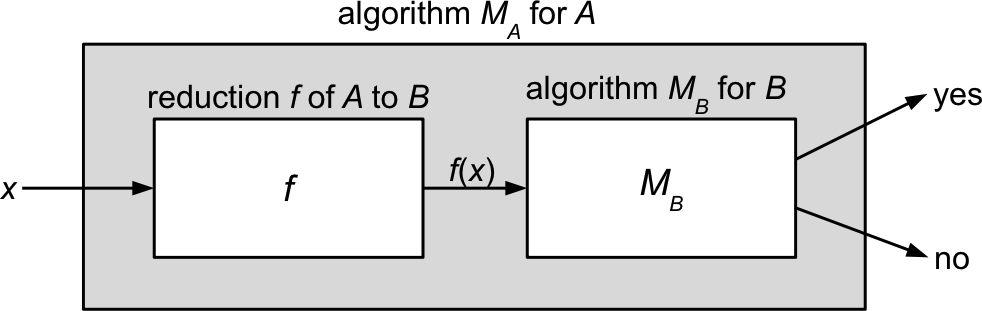
What is the time complexity of \(M_A\)? Let \(n = |x|\).
Let’s now formalize what we mean by “\(B\) is at least as hard as \(A\)”
Theorem: If \(A \le^\P B\) and \(B \in \P\), then \(A \in \P\). (“if \(B\) is easy, then \(A\) is easy”)
Corollary: If \(A \le^\P B\) and \(A \notin \P\), then \(B \notin \P\).
This corollary is the way we typically use reductions:
we know/believe \(A\) is hard, and want to show \(B\) is also hard.
Suppose we want to show that \(\probSAT\) is at least as hard as \(\probHamPath\).
Which problem should we reduce to which?
\[ \probHamPath \le^\P \probSAT \]
\[ \probHamPath \overset{f}{\longrightarrow} \probSAT \]
A Boolean formula is in conjunctive normal form (CNF) if it is a conjunction of clauses,
where each clause is a disjunction of literals (“literal” = variable or its negation). Example:
\[ \phi = \underbrace{(x \lor \overline{y} \lor \overline{z} \lor w)}_\text{clause 1} \land \underbrace{(z \lor \overline{w} \lor x)}_\text{clause 2} \land \underbrace{(y \lor \overline{x})}_\text{clause 3} \]
\(\encoding{\phi} \in \probSAT\) iff, for every clause, we can make at least one literal true.
A Boolean CNF formula \(\phi\) is a 3-CNF formula if each of its clauses has exactly 3 literals.
Example: \[
\phi = (x \lor \overline{y} \lor \overline{z}) \land (z \lor \overline{y} \lor x)
\]
\[ \probThreeSAT = \setbuild{\encoding{\phi}}{\phi \text{ is a satisfiable 3-CNF formula}} \]
This turns out to be just as hard as \(\probSAT\)!
\[ \probThreeSAT = \setbuild{\encoding{\phi}}{\phi \text{ is a satisfiable 3-CNF formula}} \]
\[ \probIndSet = \setbuild{\encoding{G, k}}{ G \text{ is an undirected graph with a } k\text{-independent set}} \]
\[ \probThreeSAT = \setbuild{\encoding{\phi}}{\phi \text{ is a satisfiable 3-CNF formula}} \]
\[ \probIndSet = \setbuild{\encoding{G, k}}{ G \text{ is an undirected graph with a } k\text{-independent set}} \]
Theorem: \(\probThreeSAT \le^\P \probIndSet\).
Proof:
Given a 3-CNF formula \(\phi\), our reduction must produce a pair \((G, k)\) such that: \[ \encoding{\phi} \in \probThreeSAT \; \iff \; \encoding{G, k} \in \probIndSet \]
Set \(k\) equal to the number of clauses in \(\phi\).
Write \(\phi\) as: \[ \phi = (a_1 \lor b_1 \lor c_1) \land (a_2 \lor b_2 \lor c_2) \land \ldots \land (a_k \lor b_k \lor c_k) \] where \(a_i, b_i, c_i\) are the three literals in clause \(i\).
G will have \(3k\) nodes,
one for each literal in \(\phi\).