Title
ECS 120 Theory of Computation
Sizes of Sets: Part 2
University of California,
Davis
\(|\R|\) vs. (open) unit interval \((0, 1)\)
- Now let’s consider some huge sets:
- The set of all real numbers \(\R\).
- The open unit interval \((0, 1) \subsetneq \R\).
- Clearly \(|(0, 1)| \le |\R|\) since \((0, 1) \subsetneq \R\).
- Surprisingly, there are the same number of real numbers in \(\R\) and in \((0, 1)\)!
- We first show the easier fact that \(|(0, 1)| \ge |\R^+|\).
- What function can we use? One example: \(g(x) = \frac{1}{x} - 1\)
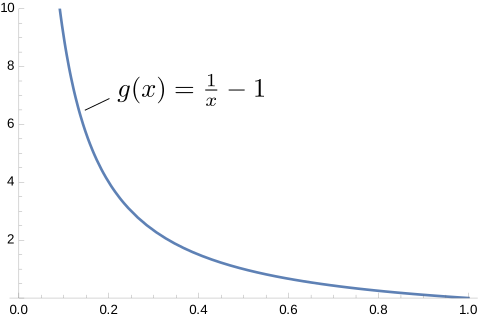
- Note that for any \(y \in \R^+\), we can solve the following for \(x \in (0, 1)\): \[ g(x) = y \quad \iff \quad x = \frac{1}{y + 1}. \]
- What function can we use? One example: \(g(x) = \frac{1}{x} - 1\)
\(|\R|\) vs. (open) unit interval \((0, 1)\)
- Now let’s consider some huge sets:
- The set of all real numbers \(\R\).
- The open unit interval \((0, 1) \subsetneq \R\).
- Clearly \(|(0, 1)| \le |\R|\) since \((0, 1) \subsetneq \R\).
- Surprisingly, there are the same number of real numbers in \(\R\) and in \((0, 1)\)!
- We first show the easier fact that \(|(0, 1)| \ge |\R^+|\).
- Second, we show that \(|\R^+| \ge |\R|\):
- What function can we use? One example: \(f(x) = \log(x)\)
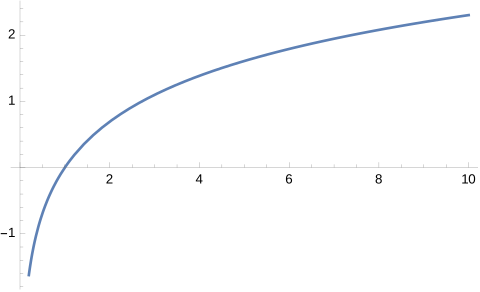
- Note that for any \(y \in \R\), we can solve the following for \(x \in \R^+\): \[ f(x) = y \quad \iff \quad x = e^y. \]
- What function can we use? One example: \(f(x) = \log(x)\)
We conclude that \(|(0, 1)| \ge |\R^+| \ge |\R|\) and so \(|(0, 1)| = |\R|\).