
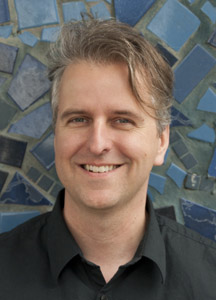
Michael Neff
Professor
Department of Computer Science and
Department of Cinema and Digital Media
University of California, Davis
Office: 3031 Kemper Hall
Phone: (530) 754-9510
Fax: (530) 752-4767
E-mail: mpneff [at] ucdavis [dot] edu
Interests
My work lies at the intersection of computation and human movement, whether that be creating models of movement to drive character animation, using computational modeling to better understand movement or using movement to interact with computers. The problems we encounter are fundamentally interdisciplinary, bridging both art and science, and benefit from a wide range or perspectives. Therefore, I collaborate with people in computer graphics, artificial intelligence, psychology, robotics, movement analysis and the performing arts.
- Character animation
- Gesture and nonverbal communication
- Virtual Reality
- Applying concepts from the performing arts to animation tools
- Physics-based models to improve motion quality
- Interactive animation
- Social and cultural impacts of technology
- Too many other things...
Group News
- 05/21: Congratulations to Simbarashe Nyatsanga on receiving an IBM PhD Fellowship! Read more about his work here.
- 04/17: We will presenting two papers at SIGGRAPH 2017 on movement/gesture and personality: Understanding the Impact of Animated Gesture Performance on Personality Perceptions and PERFORM: Perceptual Approach for Adding OCEAN Personality to Human Motion using Laban Movement Analysis.
- 16: Delighted to collaborate with Emelie Mahdavian and others on the short film Intangible Body.
- 05/16: Yingying Wang's paper Deep Signatures for Indexing and Retrieval in Large Motion Databases received the Best Paper Award at Motion in Games 2016!
- 05/16: I will be co-chairing Motion in Games 2016 in San Francisco. Submissions are due early July. Please send us your best work!
- 05/16: Checkout a new video that provides an overview of some of our work on pedagogical agents.
- 05/14: Our book on nonverbal communication for virtual characters is finally out and free online. Check it out! I wrote chapter nine.
- 02/12: I will be co-chairing IVA 2012 in Santa Cruz. Submissions are due late April and the coference is mid-September. Please send us your best work!
- 08/09: I am pleased to announce that I am now a Certified Laban/Bartenieff Movement Analyst (CLMA), having completed the two year IMS training program with Peggy Hackney, Janice Meaden and Ed Groff.
- 08/09: New work to appear at Intelligent Virtual Agents 09 and the Symposium on Computer Animation 09.
- I gratefully acknowledge recent support from the NSF through the CAREER, CreativeIT and NeTS programs.
- 03/09: Our collaboration on Collapse (suddenly falling down) is awarded the 2009 Isadora Duncan Award for Visual Design. Check out clips on YouTube.
- 08/08: Our work on gesture modelling is presented at ACM SIGGRAPH 08 in Los Angeles. You can find the TOG paper here.
- 10/07: Collapse (Suddenly Falling Down) premieres at the Mondavi Studio. This collaboration with dance professor Della Davidson and Sideshow Physical Theatre, along with members of the Geology and Computer Science departments, deployed motion capture technology in order to allow dancers to interact with LIDAR scans during the performance and also to draw new imagery.
- 09/07: Work on modeling and animating gesture receives Best Paper Award at Intelligent Virtual Agents, '07.
- 09/07: Two new graduate students, Pengcheng Luo and Yejin Kim, join the group.
- 02/07: Motion capture lab is operational. The Motion Lab has been set up featuring a twelve camera optical motion capture system in a 750' studio.
Research Support
- NSF
- CITRIS
- Autodesk
- UC Davis
Awards
- NSF CAREER Award (2009-14)
- Isadora Duncan Award for Visual Design (2009)
- Best Paper, Intelligent Virtual Agents 2007
- Alain Fournier Award (2005)
Brief Bio
Michael Neff is a professor of Computer Science and Cinema & Digital Media at the University of California, Davis where he directs the Motion Lab, an interdisciplinary research effort in character animation and embodied input. His Ph.D. is from the University of Toronto and he is also a Certified Laban Movement Analyst. His interests include character animation tools, especially modeling expressive movement, physics-based animation, gesture and applying performing arts knowledge to animation. At Davis, he is working to bridge the art and technology communities on campus, collaborating with computer scientists, dancers, choreographers and geologists. He received an NSF CAREER Award (2009-14), the Alain Fournier Award for his dissertation (2005), a best paper award from Intelligent Virtual Agents (2007) and the Isadora Duncan Award for Visual Design (2009). He currently serves as the chair for the Department of Cinema and Digital Media.Mailing Address
Department of Computer Science,
2063 Kemper Hall,
University of California, Davis,
One Shields Avenue,
Davis, CA 95616
U.S.A