Title
Closure of DFA-decidable languages under complement
- Recall the DFA \(D\) for \(L = \setbuild{x \in \{0, 1\}^*}{x \text{ contains the substring } 001}\):
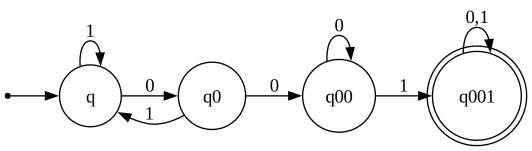
- How can we build, from \(D\), a DFA that decides \(\overline{L}\)?
- Easy: just flip which states are accepting! \(\Longrightarrow\)
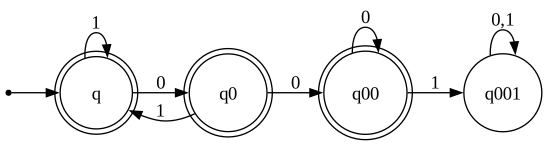 DFA deciding \(\overline{L} = \setbuild{x \in \{0, 1\}^*}{x \text{ does not contain } 001}\)
Theorem: The class of DFA-decidable languages is closed under complement.
Proof: For any language \(A\) in this class, there is a DFA \(\, D = (Q, \Sigma, \delta, s, F)\) such that \(A = L(D)\).
We can therefore construct the DFA \(\,D_c = (Q, \Sigma, \delta, s, \fragment{Q \setminus F})\) that decides \(\overline{A}\). Upon processing a string \(x\), both DFAs end in state \(q_x \in Q\). So \({x \in \overline{A} \fragment{\iff x \notin A} \fragment{\iff q_x \notin F} \fragment{\iff q_x \in Q \setminus F.}}\)
What about closure under complement of:
- NFA-decidable languages?
True! - regex-decidable languages?
True! - CFG-decidable languages?
Actually false!
Complementing an NFA
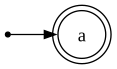
True or False: Taking the complement of an NFA’s set of accept states makes it decide the complement of its original language.
 \(\Longrightarrow\)
 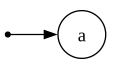 \(L(N) = \{\emptystring\}\) \(L(N_c) = \emptyset\) but \(\overline{L(N)} = \{0, 1\}^* \setminus \{\emptystring\}\)
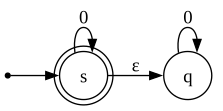 \(\Longrightarrow\)
 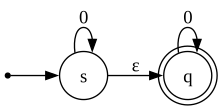 \(0 \in L(N)\) via \(s \transition{0} s\) \(0 \in L(N_c)\) via \(s \transition{\emptystring} q \transition{0} q\) but \(0 \notin \overline{L(N)}\)
What about closure under complement of:
- NFA-decidable languages?
True, but not obvious! - regex-decidable languages?
True, but not obvious! - CFG-decidable languages?
Actually false!
DFA union
To gain practice with designing constructions, let’s prove the following
Theorem: the class of DFA-decidable languages is closed under union.
In other words, if \(A = L(D_1)\) and \(B = L(D_2)\), then we must prove the existence of a DFA \(D\) such that \(A \cup B = L(D)\).
Idea: simulate \(D_1\) and \(D_2\) in parallel, and accept if either \(D_1\) or \(D_2\) accepts.
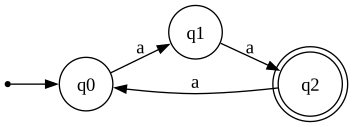 \(L(D_1) = \setbuild{a^n}{n \equiv 2 \mod 3}\)
 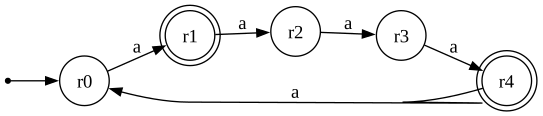 \(L(D_2) = \setbuild{a^n}{n \equiv 1 \mod 5 \; \text{ or } \; n \equiv 4 \mod 5}\)
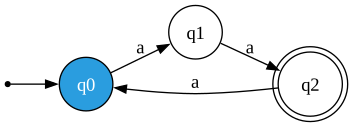 \(L(D_1) = \setbuild{a^n}{n \equiv 2 \mod 3}\)
 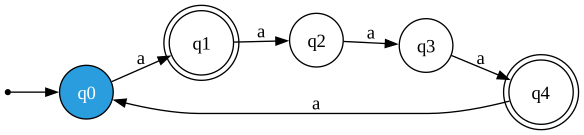 \(L(D_2) = \setbuild{a^n}{n \equiv 1 \mod 5 \; \text{ or } \; n \equiv 4 \mod 5}\)
Input string:
\(L(D_2) = \setbuild{a^n}{n \equiv 1 \mod 5 \; \text{ or } \; n \equiv 4 \mod 5}\)
Input string: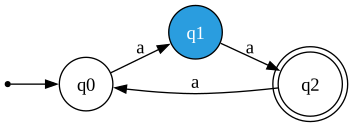 \(L(D_1) = \setbuild{a^n}{n \equiv 2 \mod 3}\)
 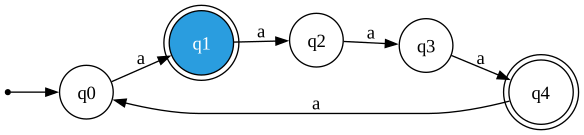 \(L(D_2) = \setbuild{a^n}{n \equiv 1 \mod 5 \; \text{ or } \; n \equiv 4 \mod 5}\)
Input string: a
\(L(D_2) = \setbuild{a^n}{n \equiv 1 \mod 5 \; \text{ or } \; n \equiv 4 \mod 5}\)
Input string: a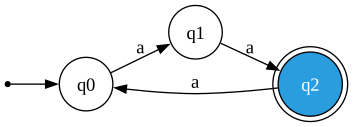 \(L(D_1) = \setbuild{a^n}{n \equiv 2 \mod 3}\)
 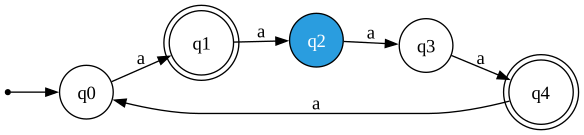 \(L(D_2) = \setbuild{a^n}{n \equiv 1 \mod 5 \; \text{ or } \; n \equiv 4 \mod 5}\)
Input string: aa\(L(D_1) = \setbuild{a^n}{n \equiv 2 \mod 3}\)
\(L(D_2) = \setbuild{a^n}{n \equiv 1 \mod 5 \; \text{ or } \; n \equiv 4 \mod 5}\)
Input string: aa\(L(D_1) = \setbuild{a^n}{n \equiv 2 \mod 3}\) 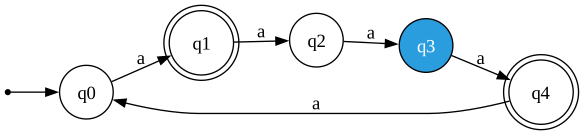 \(L(D_2) = \setbuild{a^n}{n \equiv 1 \mod 5 \; \text{ or } \; n \equiv 4 \mod 5}\)
Input string: aaa\(L(D_1) = \setbuild{a^n}{n \equiv 2 \mod 3}\)
\(L(D_2) = \setbuild{a^n}{n \equiv 1 \mod 5 \; \text{ or } \; n \equiv 4 \mod 5}\)
Input string: aaa\(L(D_1) = \setbuild{a^n}{n \equiv 2 \mod 3}\) 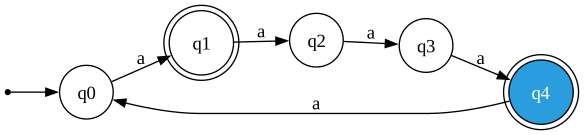 \(L(D_2) = \setbuild{a^n}{n \equiv 1 \mod 5 \; \text{ or } \; n \equiv 4 \mod 5}\)
Input string: aaaa\(L(D_1) = \setbuild{a^n}{n \equiv 2 \mod 3}\) \(L(D_2) = \setbuild{a^n}{n \equiv 1 \mod 5 \; \text{ or } \; n \equiv 4 \mod 5}\)
Input string: aaaaa\(L(D_1) = \setbuild{a^n}{n \equiv 2 \mod 3}\) \(L(D_2) = \setbuild{a^n}{n \equiv 1 \mod 5 \; \text{ or } \; n \equiv 4 \mod 5}\)
Input string: aaaaaa\(L(D_1) = \setbuild{a^n}{n \equiv 2 \mod 3}\) \(L(D_2) = \setbuild{a^n}{n \equiv 1 \mod 5 \; \text{ or } \; n \equiv 4 \mod 5}\)
Input string: aaaaaaa\(L(D_1) = \setbuild{a^n}{n \equiv 2 \mod 3}\) \(L(D_2) = \setbuild{a^n}{n \equiv 1 \mod 5 \; \text{ or } \; n \equiv 4 \mod 5}\)
Input string: aaaaaaaa\(L(D_1) = \setbuild{a^n}{n \equiv 2 \mod 3}\) \(L(D_2) = \setbuild{a^n}{n \equiv 1 \mod 5 \; \text{ or } \; n \equiv 4 \mod 5}\)
Input string: aaaaaaaaa\(L(D_1) = \setbuild{a^n}{n \equiv 2 \mod 3}\) \(L(D_2) = \setbuild{a^n}{n \equiv 1 \mod 5 \; \text{ or } \; n \equiv 4 \mod 5}\)
Input string: aaaaaaaaaa\(L(D_1) = \setbuild{a^n}{n \equiv 2 \mod 3}\) \(L(D_2) = \setbuild{a^n}{n \equiv 1 \mod 5 \; \text{ or } \; n \equiv 4 \mod 5}\)
Input string: aaaaaaaaaaa\(L(D_1) = \setbuild{a^n}{n \equiv 2 \mod 3}\) \(L(D_2) = \setbuild{a^n}{n \equiv 1 \mod 5 \; \text{ or } \; n \equiv 4 \mod 5}\)
Input string: aaaaaaaaaaaa\(L(D_1) = \setbuild{a^n}{n \equiv 2 \mod 3}\) \(L(D_2) = \setbuild{a^n}{n \equiv 1 \mod 5 \; \text{ or } \; n \equiv 4 \mod 5}\)
Input string: aaaaaaaaaaaaa\(L(D_1) = \setbuild{a^n}{n \equiv 2 \mod 3}\) \(L(D_2) = \setbuild{a^n}{n \equiv 1 \mod 5 \; \text{ or } \; n \equiv 4 \mod 5}\)
Input string: aaaaaaaaaaaaaa\(L(D_1) = \setbuild{a^n}{n \equiv 2 \mod 3}\) \(L(D_2) = \setbuild{a^n}{n \equiv 1 \mod 5 \; \text{ or } \; n \equiv 4 \mod 5}\)
Input string: aaaaaaaaaaaaaaa
\(L(D_2) = \setbuild{a^n}{n \equiv 1 \mod 5 \; \text{ or } \; n \equiv 4 \mod 5}\)
Input string: aaaa\(L(D_1) = \setbuild{a^n}{n \equiv 2 \mod 3}\) \(L(D_2) = \setbuild{a^n}{n \equiv 1 \mod 5 \; \text{ or } \; n \equiv 4 \mod 5}\)
Input string: aaaaa\(L(D_1) = \setbuild{a^n}{n \equiv 2 \mod 3}\) \(L(D_2) = \setbuild{a^n}{n \equiv 1 \mod 5 \; \text{ or } \; n \equiv 4 \mod 5}\)
Input string: aaaaaa\(L(D_1) = \setbuild{a^n}{n \equiv 2 \mod 3}\) \(L(D_2) = \setbuild{a^n}{n \equiv 1 \mod 5 \; \text{ or } \; n \equiv 4 \mod 5}\)
Input string: aaaaaaa\(L(D_1) = \setbuild{a^n}{n \equiv 2 \mod 3}\) \(L(D_2) = \setbuild{a^n}{n \equiv 1 \mod 5 \; \text{ or } \; n \equiv 4 \mod 5}\)
Input string: aaaaaaaa\(L(D_1) = \setbuild{a^n}{n \equiv 2 \mod 3}\) \(L(D_2) = \setbuild{a^n}{n \equiv 1 \mod 5 \; \text{ or } \; n \equiv 4 \mod 5}\)
Input string: aaaaaaaaa\(L(D_1) = \setbuild{a^n}{n \equiv 2 \mod 3}\) \(L(D_2) = \setbuild{a^n}{n \equiv 1 \mod 5 \; \text{ or } \; n \equiv 4 \mod 5}\)
Input string: aaaaaaaaaa\(L(D_1) = \setbuild{a^n}{n \equiv 2 \mod 3}\) \(L(D_2) = \setbuild{a^n}{n \equiv 1 \mod 5 \; \text{ or } \; n \equiv 4 \mod 5}\)
Input string: aaaaaaaaaaa\(L(D_1) = \setbuild{a^n}{n \equiv 2 \mod 3}\) \(L(D_2) = \setbuild{a^n}{n \equiv 1 \mod 5 \; \text{ or } \; n \equiv 4 \mod 5}\)
Input string: aaaaaaaaaaaa\(L(D_1) = \setbuild{a^n}{n \equiv 2 \mod 3}\) \(L(D_2) = \setbuild{a^n}{n \equiv 1 \mod 5 \; \text{ or } \; n \equiv 4 \mod 5}\)
Input string: aaaaaaaaaaaaa\(L(D_1) = \setbuild{a^n}{n \equiv 2 \mod 3}\) \(L(D_2) = \setbuild{a^n}{n \equiv 1 \mod 5 \; \text{ or } \; n \equiv 4 \mod 5}\)
Input string: aaaaaaaaaaaaaa\(L(D_1) = \setbuild{a^n}{n \equiv 2 \mod 3}\) \(L(D_2) = \setbuild{a^n}{n \equiv 1 \mod 5 \; \text{ or } \; n \equiv 4 \mod 5}\)
Input string: aaaaaaaaaaaaaaaWhat do we need to keep track of to execute this simulation?
Which pair of states are the machines in?
Closure under intersection
We already showed that the DFA-decidable languages are closed under union:
If \(A = L(D_1)\) and \(B = L(D_2)\), then we can construct \(D\) such that \(L(D) = A \cup B\).
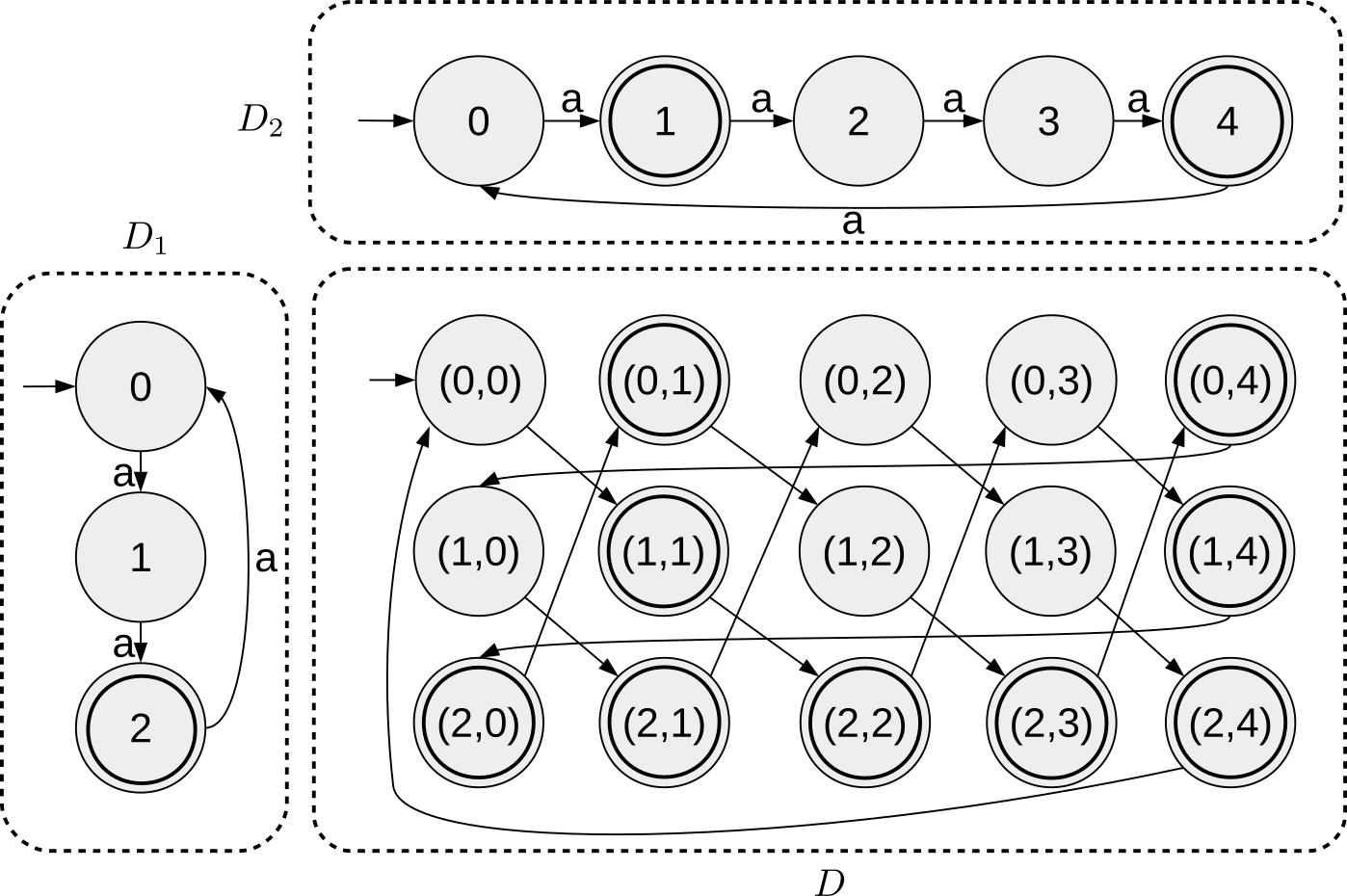
Formally:
- Let \(D_1 = (Q_1, \Sigma, \delta_1, s_1, F_1)\) and
\(\phantom{\text{Let }} D_2 = (Q_2, \Sigma, \delta_2, s_2, F_2)\) - Construct \(D = (Q, \Sigma, \delta, s, F)\):
- \(Q = Q_1 \times Q_2 = \setbuild{(p_1, p_2)}{p_1 \in Q_1 \text{ and } p_2 \in Q_2}\)
- \(s = (s_1, s_2)\)
- For all \((p_1, p_2) \in Q\) and \(a \in \Sigma\): \[\delta((p_1, p_2), a) = (\delta_1(p_1, a), \delta_2(p_2, a))\]
- \[F = \setbuild{(p_1, p_2)}{p_1 \in F_1 \text{ or } p_2 \in F_2}\]
What about intersection?
Closure under intersection
Theorem: the DFA-decidable languages are closed under intersection:
If \(A = L(D_1)\) and \(B = L(D_2)\), then we can construct \(D\) such that \(L(D) = A \color{red} \cap \color{black} B\).
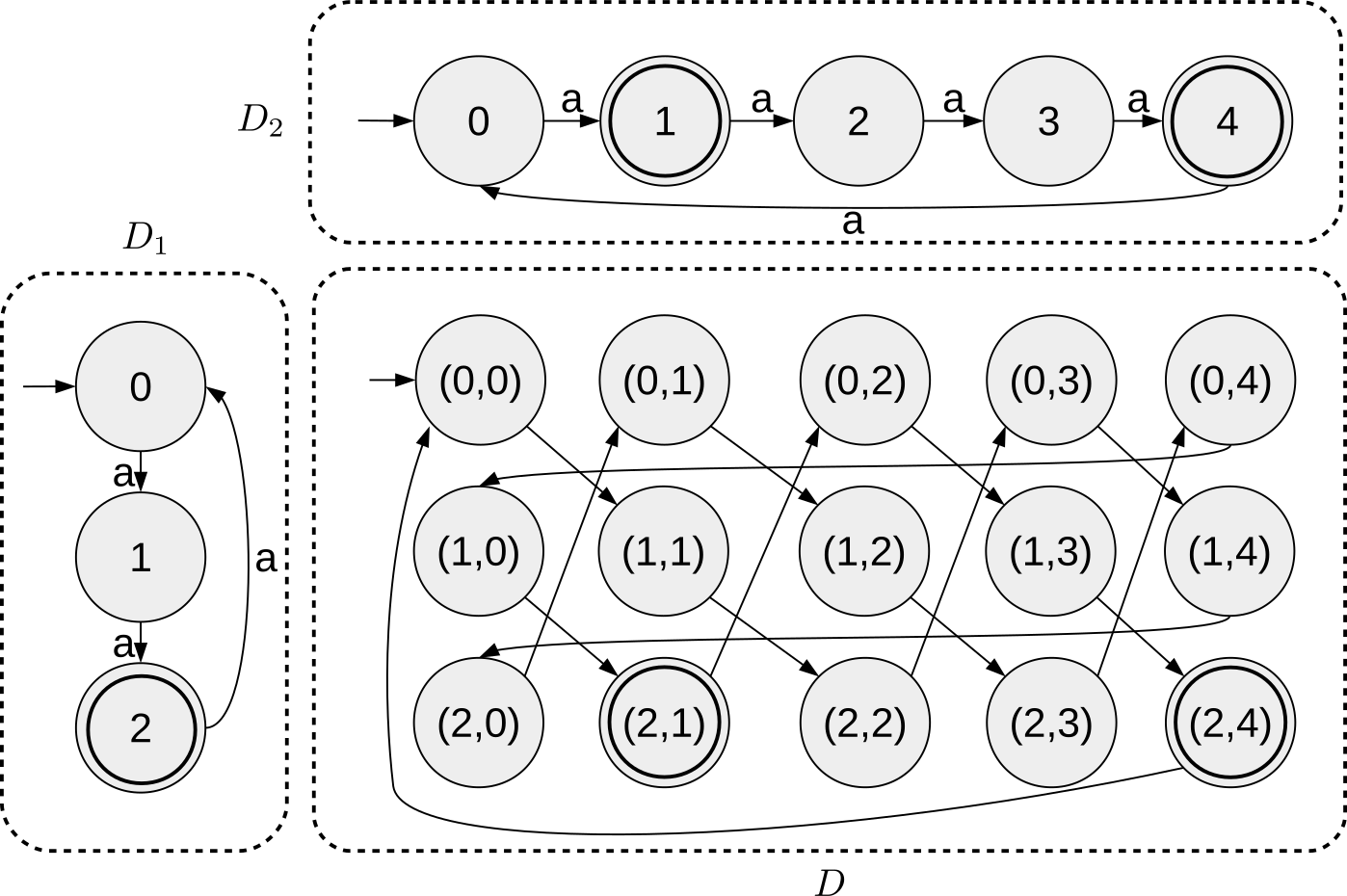
Formally:
- Let \(D_1 = (Q_1, \Sigma, \delta_1, s_1, F_1)\) and
\(\phantom{\text{Let }} D_2 = (Q_2, \Sigma, \delta_2, s_2, F_2)\) - Construct \(D = (Q, \Sigma, \delta, s, F)\):
- \(Q = Q_1 \times Q_2 = \setbuild{(p_1, p_2)}{p_1 \in Q_1 \text{ and } p_2 \in Q_2}\)
- \(s = (s_1, s_2)\)
- For all \((p_1, p_2) \in Q\) and \(a \in \Sigma\): \[\delta((p_1, p_2), a) = (\delta_1(p_1, a), \delta_2(p_2, a))\]
- \[F = \setbuild{(p_1, p_2)}{p_1 \in F_1 {\color{red} \text{ and }} p_2 \in F_2}\]
Just update the accept states! (Note now \(F = F_1 \times F_2\))
DFA concatenation attempt
Let’s consider naïvely attempting concatenation for these two DFAs:
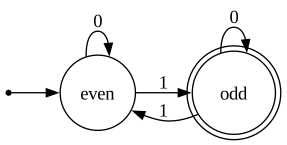
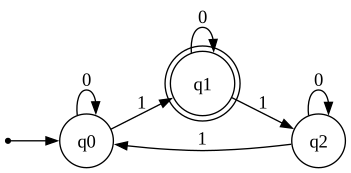
\(D_1\) \(D_2\)
If we immediately “jump” from even to q0 by redirecting the transition \(\texttt{even} \stackrel{1}{\to} \texttt{odd}\) instead to \(\texttt{even} \stackrel{1}{\to} \texttt{q0}\), then \(1111 = 111 \circ 1\) is rejected despite \(111 \in L(D_1)\) and \(1 \in L(D_2)\).
We don’t know when to transition to q0, and even if we did, we don’t know how to avoid doing it the very first time we encounter a state with a transition to q0.
The same “where and how to split?” difficulty is encountered for Kleene star.