Title
Recall: DFA concatenation attempt
Let’s consider naïvely attempting concatenation for these two DFAs:
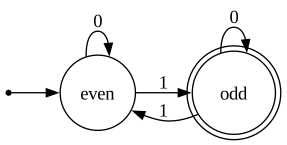
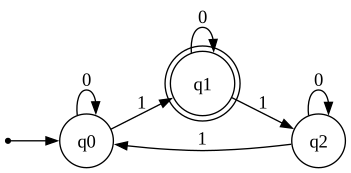
\(D_1\) \(D_2\)
If we immediately “jump” from even to q0 by redirecting the transition \(\texttt{even} \stackrel{1}{\to} \texttt{odd}\) instead to \(\texttt{even} \stackrel{1}{\to} \texttt{q0}\), then \(1111 = 111 \circ 1\) is rejected despite \(111 \in L(D_1)\) and \(1 \in L(D_2)\).
We don’t know when to transition to q0, and even if we did, we don’t know how to avoid doing it the very first time we encounter a state with a transition to q0.
The same “where and how to split?” difficulty is encountered for Kleene star.
NFAs to the rescue
The ability of an NFA to “guess” makes it simpler to construct a machine deciding the concatenation and Kleene star of languages.
Once we demonstrate how to convert an NFA to a DFA, this will prove (indirectly) that DFA-decidable languages are closed under concatenation and Kleene star.
First: how can we simplify the union construction with NFAs?
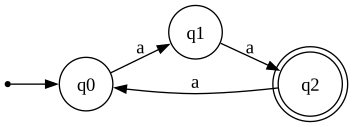
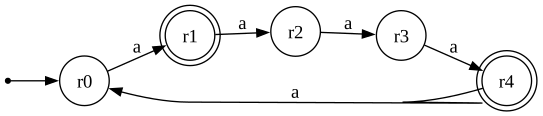
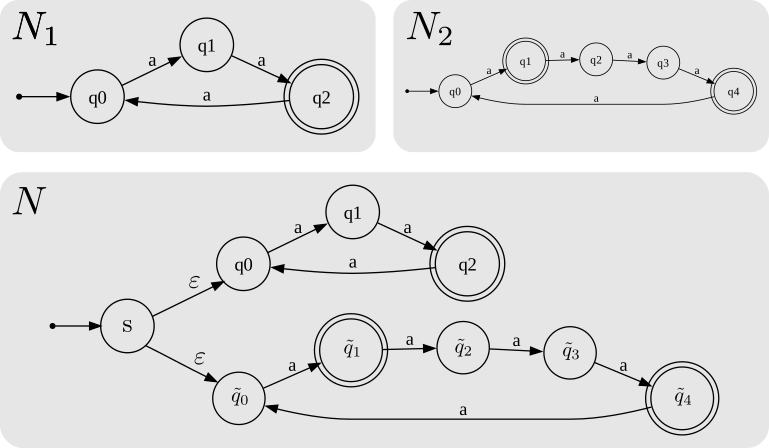
Create a new start state with \(\emptystring\)-transitions to the old start states.
Note if the two NFAs respectively have \(n\) states and \(m\) states, this has \(n + m + 1\) states, compared to \(nm\) states for the product construction.
NFAs to the rescue: Kleene star example
Consider the star of \(L(N) = \setbuild{x \in \{\string{a, b}\}^*}{ x \text{ has an odd number of } \string{b} \text{'s followed by an } \string{a}}\).
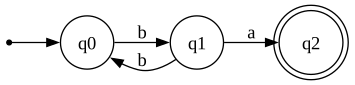
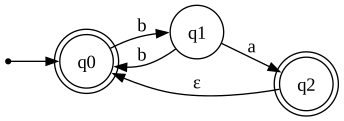
What’s a string the new NFA accepts that it should reject?
This accepts \(\string{bb}\) even though \(\string{bb} \notin L(N)^*\).
Since transitions enter q0, making it accepting alters the original NFA’s behavior.
NFAs to the rescue: Kleene star example
Consider the star of \(L(N) = \setbuild{x \in \{\string{a, b}\}^*}{ x \text{ has an odd number of } \string{b} \text{'s followed by an } \string{a}}\).
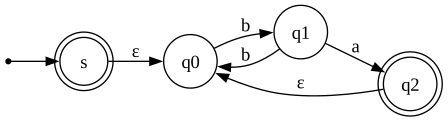
The new start state \(s\) can only be reached by \(\emptystring\), so making it accepting does not alter the original NFA’s behavior on any positive-length string.
Closure of NFA-decidable languages under union
Theorem: the NFA-decidable languages are closed under union:
If \(A = L(N_1)\) and \(B = L(N_2)\), then we can construct \(N\) such that \(L(N) = A \cup B\).
Proof:
- Let \(N_1 = (Q_1, \Sigma, \Delta_1, s_1, F_1)\) and
\(\phantom{Let }N_2 = (Q_2, \Sigma, \Delta_2, s_2, F_2)\) with \(Q_1 \cap Q_2 = \emptyset\) - Construct \(N = (Q, \Sigma, \Delta, s, F)\):
- \(Q = \fragment{Q_1 \cup Q_2} \fragment{\cup \{s\}, \text{where } s \notin Q_1 \cup Q_2 \text{ is a new state}}\)
- \(F = \fragment{F_1 \cup F_2}\)
- For all \(q \in Q\) and \(a \in \Sigma_\emptystring\): \[ \Delta(q, a) = \begin{cases} \fragment{\Delta_1(q, a)} & \text{if } q \in Q_1 \\ \fragment{\Delta_2(q, a)} & \text{if } q \in Q_2 \\ \fragment{\{s_1, s_2\}} & \text{if } q = s \text{ and } a = \emptystring \\ \fragment{\emptyset} & \text{if } q = s \text{ and } a \in \Sigma \end{cases} \]
Alternatively: the set of transitions \(\Delta\) for \(N\) is the union \(\fragment{\Delta_1} \fragment{\cup \Delta_2} \fragment{\cup \{s \stackrel{\emptystring}{\rightarrow} s_1, s \stackrel{\emptystring}{\rightarrow} s_2 \}.}\)
Closure of NFA-decidable languages under union
Theorem: the NFA-decidable languages are closed under union:
If \(A = L(N_1)\) and \(B = L(N_2)\), then we can construct \(N\) such that \(L(N) = A \cup B\).
Proof:
- \(A \cup B \subseteq L(N) \quad \big(x \in A \cup B \implies x \in L(N)\big)\)
- Suppose that \(x \in A\). Then there is a computation sequence starting at \(s_1\) (\(q_0\) in example) and ending at a state in \(F_1\).
- We extend this to a sequence for \(N\) by prepending \(\color{red} s\). Since \(F_1 \subseteq F\) this sequence shows \(N\) accepts \(x\).
- Thus \(x \in A \implies x \in L(N)\). Similarly \(x \in B \implies x \in L(N)\).
- Combining both, we have \(x \in A \cup B \implies x \in L(N)\).
- \(L(N) \subseteq A \cup B \quad \big(x \in L(N) \implies x \in A \cup B\big)\)
- When \(x \in L(N)\) there is a computation sequence \(\color{red} \smash[t]{s \stackrel{\emptystring}{\to}} \; \color{black} r_0 \to r_1 \to \ldots \to r_n\) where either
- \(r_0 = s_1\) and \((\forall i)\ r_i \in Q_1\) and \(r_n \in F_1\), or
- \(r_0 = s_2\) and \((\forall i)\ r_i \in Q_2\) and \(r_n \in F_2\).
- Then \(r_0 \to r_1 \to \ldots \to r_n\) is a computation sequence accepting \(x\) for one of \(N_1\) or \(N_2\), i.e., \(x \in A \cup B\).
- When \(x \in L(N)\) there is a computation sequence \(\color{red} \smash[t]{s \stackrel{\emptystring}{\to}} \; \color{black} r_0 \to r_1 \to \ldots \to r_n\) where either
Closure of NFA-decidable languages under concatenation
Theorem: the NFA-decidable languages are closed under concatenation:
If \(A = L(N_1)\) and \(B = L(N_2)\), then we can construct \(N\) such that \(L(N) = A \circ B\).
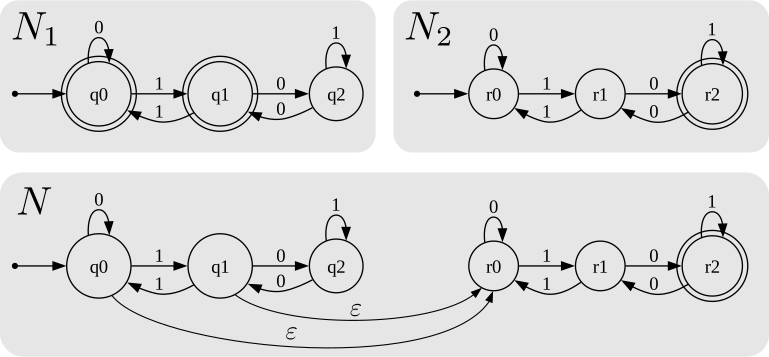
Proof:
- Let \(N_1 = (Q_1, \Sigma, \Delta_1, s_1, F_1)\) and
\(\phantom{Let }N_2 = (Q_2, \Sigma, \Delta_2, s_2, F_2)\) with \(Q_1 \cap Q_2 = \emptyset\) - Construct \(N = (Q, \Sigma, \Delta, s, F)\):
- \(Q = \fragment{Q_1 \cup Q_2}\)
- \(s = \fragment{s_1}\)
- \(F = \fragment{F_2}\)
- The set of transitions \(\Delta\) for \(N\) is \(\Delta_1 \cup \Delta_2 \cup \fragment{\setbuild{q \stackrel{\emptystring}{\rightarrow} s_2}{q \in F_1}}\).
Alternatively, for all \(q \in Q\) and \(a \in \Sigma_\emptystring\), \[ \Delta(q, a) = \begin{cases} \Delta_1(q, a) & \text{if } (q, a) \in Q_1 \times \Sigma_\emptystring \setminus F_1 \times \{\varepsilon\} \\ \Delta_2(q, a) & \text{if } q \in Q_2 \\ \Delta_1(q, a) \cup \{s_2\} & \text{if } q \in F_1 \text{ and } a = \emptystring \end{cases} \]
Closure of NFA-decidable languages under concatenation
Theorem: the NFA-decidable languages are closed under concatenation:
If \(A = L(N_1)\) and \(B = L(N_2)\), then we can construct \(N\) such that \(L(N) = A \circ B\).
Proof:
- \(A \circ B \subseteq L(N) \ \ \big(w \in A \circ B \implies w \in L(N)\big)\)
- Suppose that \(w \in A \circ B\).
Then \(w = x y\) where \(x \in A\) and \(y \in B\). - Then there are computation sequences:
- \(s_1, r_2, \ldots, r_n\) for \(N_1\) accepting \(x\) (with \(r_n \in F_1)\)
- \(s_2, t_2, \ldots, t_m\) for \(N_2\) accepting \(y\) (with \(t_m \in F_2)\)
- We can combine these into the (accepting) computation sequence for \(N\) on \(w\) \[s_1, r_2, \ldots, r_n, s_2, t_2, \ldots, t_m\] using the transition \(r_n \stackrel{\emptystring}{\to} s_2\).
- Since \(s = s_1\) and \(t_m \in F\), this sequence proves that \(N\) accepts \(w\).
- Suppose that \(w \in A \circ B\).
Closure of NFA-decidable languages under concatenation
Theorem: the NFA-decidable languages are closed under concatenation:
If \(A = L(N_1)\) and \(B = L(N_2)\), then we can construct \(N\) such that \(L(N) = A \circ B\).
Proof:
- \(L(N) \subseteq A \circ B \ \ \big(w \in L(N) \implies w \in A \circ B\big)\)
- Suppose \(w \in L(N)\). Then there is a computation
sequence $s=r_0, r_1,, r_2, , r_n $, with \(r_n \in F=F_1\) - By construction, all paths through \(N\) reaching a
state in \(F\) must take an \(\varepsilon\)-transition from \(r_k \in F_1\) to \(s_2\). - Thus, we can split the sequence into two parts: \(s_1=r_0, \ldots, r_k\) and \(s_2=r_{k + 1}, \ldots, r_n\).
- \(r_0, \ldots, r_k\) is an accepting sequence for \(N_1\) on \(x \prefix w\) \(\fragment{\implies x \in A}\)
- \(r_{k + 1}, \ldots, r_n\) is an accepting sequence for \(N_2\) on the remaining part \(y\) of \(w\) \(\fragment{\implies y \in B}\)
- Thus, \(w = x y\) where \(x \in A\) and \(y \in B\), meaning \(w \in A \circ B\).
- Suppose \(w \in L(N)\). Then there is a computation
Closure of NFA-decidable languages under Kleene star
Theorem: The NFA-decidable languages are closed under Kleene star:
If \(A = L(N_1)\), then we can construct \(N\) such that \(L(N) = A^*\).
\(N_1\) \(N\)
Proof:
Let \(N_1 = (Q_1, \Sigma, \Delta_1, s_1, F_1)\) and construct
\(N = (Q, \Sigma, \Delta, s, F)\):
- \(Q = Q_1 \cup \{s\}\)
- \(F = F_1 \cup \{s\}\)
- The set of transitions \(\Delta\) for \(N\) is
\(\Delta_1 \cup \fragment{\{s \stackrel{\emptystring}{\rightarrow} s_1 \} \cup} \fragment{\setbuild{q \stackrel{\emptystring}{\rightarrow} s_1}{q \in F_1}}\).
Alternatively, for all \(q \in Q\) and \(a \in \Sigma_\emptystring\), \[ \Delta(q, a) = \begin{cases} \Delta_1(q, a) & \text{if } (q, a) \in Q_1 \times \Sigma_\emptystring \setminus F_1 \times \{\varepsilon\} \\ \Delta_1(q, a) \cup \{s_1\} & \text{if } q \in F_1 \text{ and } a = \emptystring \\ \{s_1\} & \text{if } q = s \text{ and } a = \emptystring \\ \emptyset & \text{if } q = s \text{ and } a \ne \emptystring \end{cases} \]
Closure of NFA-decidable languages under Kleene star
Theorem: The NFA-decidable languages are closed under Kleene star:
If \(A = L(N_1)\), then we can construct \(N\) such that \(L(N) = A^*\). (proof of \(A^* \subseteq L(N)\))

- Clearly \(\emptystring \in L(N)\) since \(s \in F\), so below we only consider non-empty strings.
- To show \(A^* \subseteq L(N)\), let \(x \in A^* \setminus \{\emptystring\}\).
- Then \(x = x_1 x_2 \dots x_k\), where each \(x_j \in L(N_1) \setminus \{\emptystring\}\).
- For each \(1 \le j \le k\), there is a computation sequence \(q_{j,0}, q_{j,1}, \dots, q_{j,m_j} \in Q\), with \(q_{j,0} = s_1\) and \(q_{j,m_j} \in F_1\), and there is a sequence \(y_{j,0}, y_{j,1}, \dots, y_{j,m_j} \in \Sigma_\varepsilon\), where
\(x_j = y_{j,0} y_{j,1} \dots y_{j,m_j}\), and for each \(0 \le i < m_j\), a transition \(q_{j,i} \stackrel{y_{j,i}}{\to} q_{j,i+1}\). - Then the following is a computation sequence showing \(N\) accepts \(x\):
\(s, \underbrace{s_1(=q_{1,0}), q_{1,1}, \dots, q_{1,m_1}}_{x_1}, \underbrace{s_1(=q_{2,0}), q_{2,1}, \dots, q_{2,m_1}}_{x_2}, \dots, \underbrace{s_1(=q_{k,0}), q_{k,1}, \dots, q_{k,m_k}}_{x_k}\).
Closure of NFA-decidable languages under Kleene star
Theorem: The NFA-decidable languages are closed under Kleene star:
If \(A = L(N_1)\), then we can construct \(N\) such that \(L(N) = A^*\). (proof of \(L(N) \subseteq A^*\))
- To show \(L(N) \subseteq A^*\), let \(x \in L(N) \setminus \{\emptystring\}\). (similar to before, clearly \(\emptystring \in A^*\), so we assume \(|x|>0\))
- Then there are sequences \(q_0,\dots,q_m \in Q'\) and \(y_0,\dots,y_{m-1} \in \Sigma_\varepsilon\) such that \(q_0=s,q_m \in F\),
\(x = y_0 y_1 \dots y_{m-1}\), and for all \(0 \le i < m\), a transition \(q_i \stackrel{y_i}{\to} q_{i+1}\). - The start state \(s=q_0\) has no outgoing non-\(\varepsilon\) transitions, so the first transition \(q_0 \stackrel{y_0}{\to} q_1\) is \(s \stackrel{\varepsilon}{\to} s_1\).
- Since there’s no transitions back to \(s\), we have \(q_m \ne s\), so \(q_m \in F_1\).
- Suppose for \(k \ge 1\) there are \(k−1\) \(\varepsilon\)-transitions from a state in \(F_1\) to \(s_1\) in the computation sequence \(q_1,\dots,q_m\), then we can write the sequence as \(s_1,q_{1,1},\dots,q_{1,m_1},\) \(s_1,q_{2,1},\dots,q_{2,m_2},\) \(\dots,\) \(s_1,q_{k,1},\dots,q_{k,m_k},\) where each \(q_{j,m_j} \in F_1\).
- Then each substring \(x_j\) taking \(N\) from \(s_1\) to \(q_{j,m_j}\) is in \(A \setminus \{\emptystring\}\), i.e., \(x = x_1x_2\dots x_k \in A^*\).