Title
Recall: Operation of an NFA
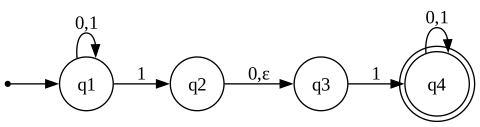
Example processing the string 010110:
010110
Begin in the state(s) \(\{a\}\).
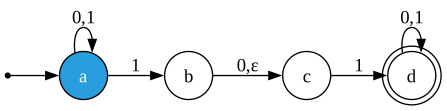
Read
0and transition to state(s) \(\{a\}\).010110
Read
1and transition to state(s) \(\{a, b, c\}\).010110
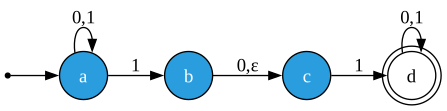
Read
0and transition to state(s) \(\{a, c\}\).010110
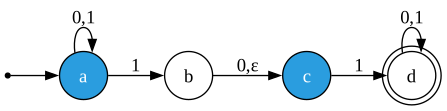
Read
1and transition to state(s) \(\{a, b, c, d\}\).010110
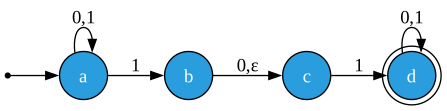
Read
1and transition to state(s) \(\{a, b, c, d\}\).010110
Read
0and transition to state(s) \(\{a, c, d\}\).010110
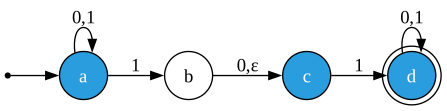
Since an accept state is highlighted, the NFA accepts the string.
What would a DFA need to keep track of in order to simulate this NFA?
Example NFA to DFA conversion
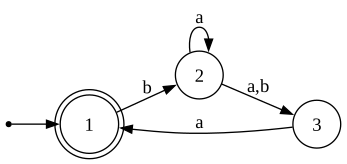
Example NFA to DFA conversion
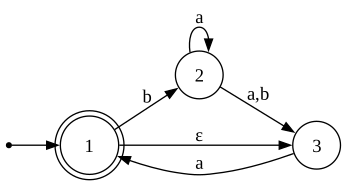
- This process usually does not generate “optimal” DFAs.
- In this example, we could remove unreachable states.
- For proving equivalence, we don’t care about optimality!
So we do not remove states in general.
Example NFA to DFA conversion
- This process usually does not generate “optimal” DFAs.
- In this example, we could remove unreachable states.
- For proving equivalence, we don’t care about optimality!
So we do not remove states in general.
There are \(k\)-state NFAs for which the smallest equivalent DFA has \(2^k\) states!
Example near this bound:
\(k^\text{th}\)-to-last symbol NFA
NFA to DFA conversion: Subset construction
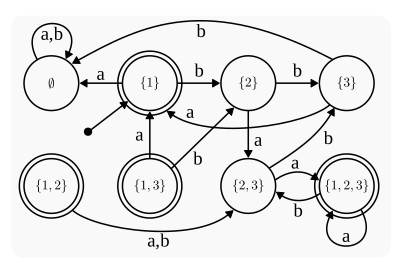
Theorem: Every NFA-decidable language is DFA-decidable.
Proof (no \(\emptystring\) transitions)
- Let \(N = (Q_N, \Sigma, \Delta_N, s_N, F_N)\) be an NFA without \(\emptystring\)-transitions.
- Construct \(D = (Q_D, \Sigma, \delta_D, s_D, F_D)\) as follows:
- \(Q_D = \powerset(Q_N)\)
- \(s_D = \{s_N\}\)
- \(F_D = \fragment{\setbuild{R \in Q_D}{\fragment{R \cap F_N \neq \emptyset}}}\)
- For all \(R \in Q_D\) and \(b \in \Sigma\): \[\delta_D(R, b) = \bigcup_{q \in R} \Delta_N(q, b)\]
- What about \(\emptystring\) transitions? Convention:
- After reading each symbol, jump to all states reachable by any number of \(\emptystring\)-transitions.
- Also do this for the start state.
Following \(\emptystring\)-transitions
For any \(R \subseteq Q_N\), define: \[ E(R) = \setbuild{q \in Q_N}{q \text{ is reachable from some $r \in R$ by a sequence of 0 or more $\emptystring$-transitions}} \]
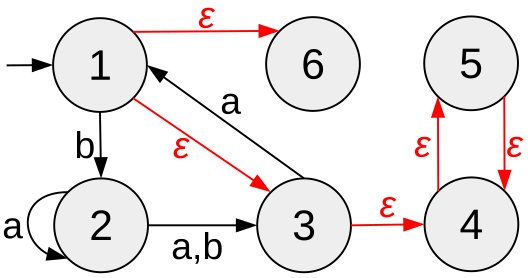
- \(E(\{5\}) = \fragment{\{4, 5\}}\)
- \(E(\{6\}) = \fragment{\{6\}}\)
- \(E(\{1\}) = \fragment{\{1, 3, 4, 5, 6\}}\)
- \(E(\{2\}) = \fragment{\{2\}}\)
- \(E(\{3\}) = \fragment{\{3, 4, 5\}}\)
- \(E(\{2, 5\}) = \fragment{\{2, 4, 5\}}\)
NFA to DFA conversion: “Subset construction”
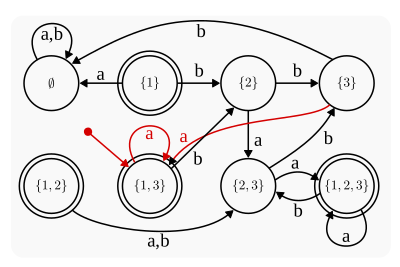
Theorem: If a language is NFA-decidable, then it is also DFA-decidable.
Proof
- Let \(N = (Q_N, \Sigma, \Delta_N, s_N, F_N)\) be an NFA.
- Construct \(D = (Q_D, \Sigma, \delta_D, s_D, F_D)\) as follows:
- \(Q_D = \powerset(Q_N)\)
- \(\color{red} s_D = \fragment{E(\{s_N\})}\)
- \(F_D = \setbuild{R \in Q_D}{R \cap F_N \neq \emptyset}\)
- For all \(R \in Q_D\) and \(b \in \Sigma\): \[\color{red} \delta_D(R, b) = \fragment{E\left(\bigcup_{q \in R} \Delta_N(q, b)\right)}\]
This convention for handling \(\emptystring\)-transitions is not the only possible one!
Corollary: a language is DFA-decidable if and only if it is NFA-decidable.